Age Ten: The Hush of Ice and Death

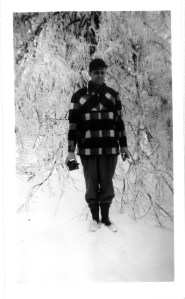
My dad after the ice storm

People might think of Mississippi and imagine almost tropical weather. Along the coast, that’s true, but in the hills of the north, the winters can be harsh, and it’s not that unusual to see snow. Snow immobilizes us Southerners, but the worst winter weather element is ice.

The winter before I turned ten, we had a terrible ice storm. I remember thinking how beautiful it was at first, that fine glazing of everything in a shimmer of ice, but as the ice got heavier and weighed down the trees, some of them bent, and others snapped. So did the power lines. The frightening sound of limbs breaking and big trees coming down went on all night long. We woke to a wonderland of white and crystal, blinding in the sunlight.

We were without power for at least a week, but we were a hardy lot. Or at least, my parents and grandparents were. I remember candles and kerosene lamps, and biscuits and scrambled eggs cooked on top of an oil stove that was our only source of heat.

Papaw and me

My grandfather’s health was failing by then. I’ve told you that I grew up in a kind of hushed atmosphere because of his illness, and as he grew sicker, there was a pall over that house. My bedroom was next to my grandparents’, and I would hear his coughing all through the night. I still have a vivid image of him, gaunt and frail, propped against pillows, smoking a Lucky Strike, listening to a baseball game on the radio.

The funeral was held at our house. It was what he had wanted; no fine church funeral for him, and there was no funeral home in town. Somebody moved all the living and dining room furniture out except for the piano and brought folding chairs in. In the dining room the casket sat on sawhorses draped in black velvet. It was February, and carnations were the flower of choice. To this day I can’t abide the smell of carnations.

I remember how we stood in the hall, my mother, my grandmother, and I, waiting to go in for the viewing. My heart pounded. I wanted to run. I was ten years old. I could not imagine death. When my grandmother leaned over and kissed my grandfather in his casket, I was astonished. How could she do that? What did it feel like to kiss the dead?

My grandfather became a character in a story about a boy, Jack, whose father deserts the family, and Jack and his mother go to live with the paternal grandfather. The grandfather–Pop–teaches Jack to smoke when he’s thirteen. After that they often smoke together. When Pop is dying, he asks Jack to bring him a cigarette, which creates a dilemma for Jack. It’s against doctor’s orders, but what can it hurt?

Here’s a bit of “Smokers” (the “I” is Jack, the grandson):

I raised all the windows in the room and switched on the attic fan we used only on the hottest nights because Mama complained that it gave her sinus trouble and made Pop’s coughing worse. When I handed him the cigarette, his hands shook so that he dropped it.

“Light it for me, Jack,” he said. “I don’t think I can do it.”

Now that we’d tricked Mama into leaving, I was getting scared. “Pop, I don’t think this is a good idea. Maybe—”

“Please, son. Just light it.”

I had gotten pretty good with practice. The old lighter flicked once, twice, then caught. I lit the cigarette and handed it to him. I had to cup my hands around his to steady it. I was surprised at how deeply he was able to inhale and exhale. Then he held the cigarette himself, balancing it between two fingers of his right hand, almost gracefully. He leaned back, closed his eyes, and let out the longest sigh I ever heard. For one awful moment, I thought he might be dying, but when he opened his eyes, they were light and alive. He wagged the cigarette at me and said, “Don’t you want one?”

“Yes sir. I do.” I lit up, too, and we sat there and smoked together. I watched the clock, and when I figured we had only a few minutes to spare, I pulled the Juicy Fruit from my pocket and took his cigarette and mine outside and crushed them in the dirt under the shrubbery next to the house.

My heart was pounding when I walked back into his room. There was no way that Mama, with her practiced, keen sense of smell, wouldn’t notice cigarette smoke. I stood in the middle of the floor like I’d been nailed to it, not knowing what to do.

What age was a turning point in your awareness of death? Was there a time in  your childhood when you felt deeply threatened or frightened? Tell me about it in a comment, or if you don’t want to share, write it down. I believe you’ll be glad you did.

This post is the tenth in a series of memoirs in response to Jane Ann McLachlan’s October Memoir and Backstory Blog Challenge.

Age Seven: An Awakening

Along about this time, an incident took place that nagged at me for years. It has become a short story, but I won’t print it here. I think the memory suffices.

I may have been younger than seven; I can’t swear to how old I was. I was old enough for what happened to make an impression but not old enough to understand the implications.

From my earliest memories, we always had a maid. Some people had cooks, too, or a woman who could both cook and clean. Our maid was mainly a housekeeper. She came every day, I think, although I can’t imagine why. The incident I’m remembering happened in the summer. The maid–I’ll call her Rose–came to work with her two or maybe three children, all close to my age, in tow. When Rose showed up at the back door, my mother was miffed. Rose explained that she didn’t have anybody to keep the children, and rather than miss work, she had brought them with her. I can hear her voice in my head: “They won’t be no trouble, Miss Carra. They play outside, they be fine.”

Mother had some project underway–making jelly, maybe–so she needed Rose to stay. She told the children to go play in the yard, and Rose came inside and went to work. The trouble was, I wanted to play with them. I nagged at my mother until she gave in, but she lectured me to “keep my distance” and to come in when she called. I wondered aloud why those kids couldn’t come inside to play. I got no answer.

So I went out to play with the black children, and we wound up under the walnut tree where the swing was. I don’t remember if any of us played on the swing. I had a package of balloons in my pocket, precious treasure from a trip to the dime store a day or two before. I brought them out, and we children sat in the dirt and began to blow up balloons. The fun got out of hand when I showed them how to blow them up and let them go so they went buzzing and flying all around us. Hysterical with laughter, we began to swap balloons, blow them up, let them go.

Balloons
Image by jdurham/www.morguefile.com

And then my mother showed up. Red-faced with fury, she demanded to know what we were doing, but I didn’t have to tell her. She had been watching us. She yanked me up by the arm and dragged me into the house. All my balloons were left behind.

I don’t recall what happened after that. I suppose the black children stayed on and played in the yard. In my fictional version, their mother takes her dignity and her children and walks away from that job. I’d like to think that was true, but I doubt it. Whatever happened, I was left with the feeling that something wasn’t right.

In fairness to my mother, she had reason to be concerned about me and “germs.” I was sick a lot in those days. She would not have considered herself a racist. It was all she knew. It was what I learned, too: a cultural context of racism that I wouldn’t unlearn for many years. That day, though, for a little while, we children saw only those brightly colored balloons. The color of our skin didn’t matter.

I wonder how those children felt, having their playmate taken away from them, or if the left-behind balloons were enough. I wonder if they sensed the discrimination at the heart of it and if the story stayed with them the way it has stayed with me.

If Mama’s Not Happy: A Sad Story

This is the fifth entry in Jane Ann McLachlan’s October Memoir and Backstory Blog Challenge.

Fifth birthday

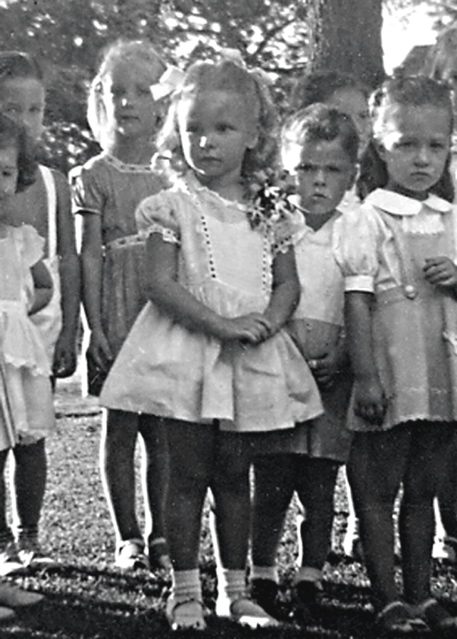
At my fifth birthday party

Nobody looks happy. That’s me in the middle, wearing the corsage of tuberoses.

The most striking memory from that time has made its way into my fiction. I must have been five, maybe six, when my mother bought a beautiful red suit. I don’t remember her trying it on, but I’m sure she must have modeled it for my father. She would have been so pretty wearing it. What I remember is her crying in the kitchen after he told her she’d have to take it back.

“We can’t afford it,” he said.

I was old enough to be distressed by my mother’s tears but not old enough to understand the complexity of love or the helplessness of witnessing someone else’s sadness.

My father had grown up during the depression. He had sold the service station by then and opened an automobile parts store. He went to work at six in the morning and came home at six at night, six days a week. He would have given my mother and me the world, if he could, but he saw that red suit as an extravagance. (It probably was.)

My mother did what he said. She took the red suit back.

Memory turns to story

That memory translated many years later into a short story set in the 1950s about a young farm wife who has had a stillborn child. The baby’s room has been cleared out, and her husband is at work on the farm all day. She goes into town to take some unused baby clothes back to the local store and sees a red dress in the store window. She uses the store credit to buy the dress.

Here’s a bit of “From This Distance,”* published in Arkansas Review some years ago:

Iris opens the box and unfolds the tissue. The silk dress isn’t fire engine red, but something different: maybe the color of maple leaves in late October. She lifts it out of the tissue and holds it up. Sunlight filters through it. She unbuttons her cotton dress and lets it drop to the floor, and the red dress floats down over her body like water. She can only see herself from the hips up in the mirror, but the dress looks fine. She feels pretty in it.  

That afternoon, she gathers fresh tomatoes, cucumbers, and onions from the garden and makes Peter’s favorite buttermilk dressing. She puts a ham in the oven to bake and makes bread, potato salad, and a lemon icebox pie. She sets the table in the dining room with their wedding china and puts a basket of daisies in the middle. Then she bathes, puts on a little makeup, dresses, and pins her hair up the way Peter likes it. By the time she hears him pull up to the barn on the tractor, she’s been ready and waiting for an hour. 

When Peter walks in, he slaps his keys on the kitchen counter, drops into a dinette chair, and rubs his hands over his face hard before he sees her standing there. He looks her up and down. “Where’d you get that dress?”

Iris smiles, but already she feels the stirring of what she’d felt in the yard that morning, that at any moment she might fly apart. “At Gordon’s,” she says. She smooths her hands down the front of the dress. 

Peter scrapes the chair back, goes to the refrigerator, and takes out a beer. He rummages through a drawer for the opener, tosses the top into the trash can under the sink, leans back against the counter, and takes a drink. All before he speaks. “How much did you pay for it?” 

She hasn’t thought about having to explain about the credit. 

Peter waggles the beer bottle at her. “Too much, I’d bet.”

“I don’t see what—”

“You’ll have to take it back. We can’t afford anything extra right now. Not until I see for sure what the crops are going to do. It’s too risky.” He drains the bottle and drops it in the trash can. “You know that.”

“I know, but I thought it would be nice if we—if I—fixed myself up a little. I thought—”

“Never mind what you thought. Go take it off before you get something on it and they won’t take it back. What do you need a red dress for? You can’t wear it to church. It’s cut too low.”           

Iris lowers herself into a chair, her heart pounding. This isn’t the way things are supposed to go. She fingers the skirt. So soft. Tears well up, and he sees. He walks over and pulls her up out of the chair and holds her. “I know you want it. Maybe next spring, you can buy yourself something special, but not now.” He lets her go. “I’m going to take a shower. Supper smells good.” He walks out of the room . . . 

She sits still for a minute, then stands up heavily and walks out of the kitchen, feeling more cumbersome than when she was pregnant.

My mother never saw any of my writing. I’d like to think it’s okay with her for me to use “her” material.

When were you first aware of someone else’s sadness or anger? How did it make you feel? Have you used that emotion in your writing? 

*If anyone is interested in reading all of “From This Distance,” you can find it atEBSCOhost (the Arkansas Review doesn’t maintain an online archive). I’m a little hesitant to recommend it to you since it was written a long time ago, and as I edited here, I found myself revising it!