Story Surgery

I re-read a short story recently that I had put away because I didn’t know what to do with it. I’d submitted it a few times with no luck—a sign the story isn’t bad, but it’s not as good as it could be.
I had never been satisfied with the ending, so I started there. I pushed words around. I cut them. I agonized. I lost sleep. I worked on the last two paragraphs for days (yes, sometimes that’s how long it takes), and finally, the ending seemed to gel. No small victory. I thought the story was almost ready to send out.

But then I read it again—one last time, I told myself. I checked white space and typos. I read for clichés, sentence variety, scene and narrative summary balance, tension, character arc and change . . . If you’re a fiction writer, you know the drill. As I read, I remembered a masterful writer of fiction once asked in a workshop: “Does every sentence belong? What does it add to the story?” And my heart sank. The story was still heavy with gratuitous details and phrases, even whole sentences that didn’t contribute much.

So I started cutting. By the time I was done, the story was almost 500 words lighter. Tighter. Stronger. Why had it taken me so long to see what it needed?

Sometimes, time and distance give me perspective. I agree with the advice to “put it away for a while,” then reread with a sharp, critical eye. I often puzzle over a story for a long time before I figure out what it needs. Occasionally, I never figure it out, but that’s another post.

“Does every sentence belong? What does it add to the story?”

Someone—surely more than one writer of advice on story craft—has said that nothing should go in the story that doesn’t advance it in some way. 

I believe that’s the crux of revision whether you’re writing short or long fiction.

Ask yourself: Does this scene (substitute paragraph, dialogue, sentence, image, particular word—yes, it comes down to word choice!) move the story forward and/or grow the character? What does it add? Strike it out and read the passage aloud without it. See if you miss it, not because it was a brilliant turn of phrase but because without it, something absolutely essential has gone missing from the story. If not, cutCut. Cut. Painful, but necessary.

Be wary of language that calls attention to itself. In this story, I threw away a metaphor I loved, a beautiful image, but it didn’t do anything for the story. Sometimes we do have to “kill our darlings.”

Granted, it’s possible to chop the life right out of a story. I know. I’ve done it. But sometimes, if we cut a story to its bones, we find a better way to tell it.

How does “chopping” figure into your revision process?

This post has also been published at Story Circle Network.

Image courtesy of Vecteezy.com.
If Mama’s Not Happy: A Sad Story

This is the fifth entry in Jane Ann McLachlan’s October Memoir and Backstory Blog Challenge.

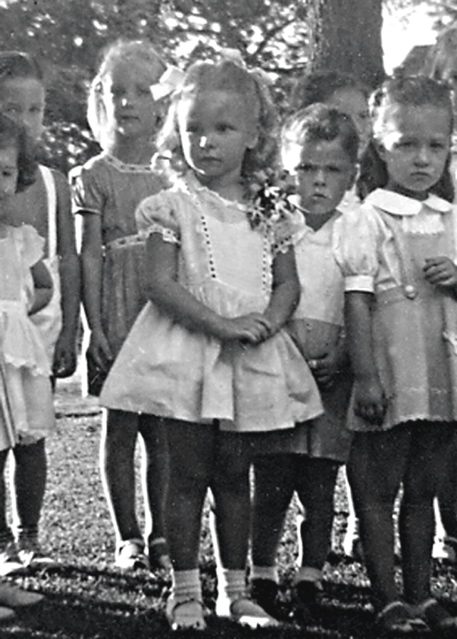
Fifth birthday

At my fifth birthday party

Nobody looks happy. That’s me in the middle, wearing the corsage of tuberoses.

The most striking memory from that time has made its way into my fiction. I must have been five, maybe six, when my mother bought a beautiful red suit. I don’t remember her trying it on, but I’m sure she must have modeled it for my father. She would have been so pretty wearing it. What I remember is her crying in the kitchen after he told her she’d have to take it back.

“We can’t afford it,” he said.

I was old enough to be distressed by my mother’s tears but not old enough to understand the complexity of love or the helplessness of witnessing someone else’s sadness.

My father had grown up during the depression. He had sold the service station by then and opened an automobile parts store. He went to work at six in the morning and came home at six at night, six days a week. He would have given my mother and me the world, if he could, but he saw that red suit as an extravagance. (It probably was.)

My mother did what he said. She took the red suit back.

Memory turns to story

That memory translated many years later into a short story set in the 1950s about a young farm wife who has had a stillborn child. The baby’s room has been cleared out, and her husband is at work on the farm all day. She goes into town to take some unused baby clothes back to the local store and sees a red dress in the store window. She uses the store credit to buy the dress.

Here’s a bit of “From This Distance,”* published in Arkansas Review some years ago:

Iris opens the box and unfolds the tissue. The silk dress isn’t fire engine red, but something different: maybe the color of maple leaves in late October. She lifts it out of the tissue and holds it up. Sunlight filters through it. She unbuttons her cotton dress and lets it drop to the floor, and the red dress floats down over her body like water. She can only see herself from the hips up in the mirror, but the dress looks fine. She feels pretty in it.  

That afternoon, she gathers fresh tomatoes, cucumbers, and onions from the garden and makes Peter’s favorite buttermilk dressing. She puts a ham in the oven to bake and makes bread, potato salad, and a lemon icebox pie. She sets the table in the dining room with their wedding china and puts a basket of daisies in the middle. Then she bathes, puts on a little makeup, dresses, and pins her hair up the way Peter likes it. By the time she hears him pull up to the barn on the tractor, she’s been ready and waiting for an hour. 

When Peter walks in, he slaps his keys on the kitchen counter, drops into a dinette chair, and rubs his hands over his face hard before he sees her standing there. He looks her up and down. “Where’d you get that dress?”

Iris smiles, but already she feels the stirring of what she’d felt in the yard that morning, that at any moment she might fly apart. “At Gordon’s,” she says. She smooths her hands down the front of the dress. 

Peter scrapes the chair back, goes to the refrigerator, and takes out a beer. He rummages through a drawer for the opener, tosses the top into the trash can under the sink, leans back against the counter, and takes a drink. All before he speaks. “How much did you pay for it?” 

She hasn’t thought about having to explain about the credit. 

Peter waggles the beer bottle at her. “Too much, I’d bet.”

“I don’t see what—”

“You’ll have to take it back. We can’t afford anything extra right now. Not until I see for sure what the crops are going to do. It’s too risky.” He drains the bottle and drops it in the trash can. “You know that.”

“I know, but I thought it would be nice if we—if I—fixed myself up a little. I thought—”

“Never mind what you thought. Go take it off before you get something on it and they won’t take it back. What do you need a red dress for? You can’t wear it to church. It’s cut too low.”           

Iris lowers herself into a chair, her heart pounding. This isn’t the way things are supposed to go. She fingers the skirt. So soft. Tears well up, and he sees. He walks over and pulls her up out of the chair and holds her. “I know you want it. Maybe next spring, you can buy yourself something special, but not now.” He lets her go. “I’m going to take a shower. Supper smells good.” He walks out of the room . . . 

She sits still for a minute, then stands up heavily and walks out of the kitchen, feeling more cumbersome than when she was pregnant.

My mother never saw any of my writing. I’d like to think it’s okay with her for me to use “her” material.

When were you first aware of someone else’s sadness or anger? How did it make you feel? Have you used that emotion in your writing? 

*If anyone is interested in reading all of “From This Distance,” you can find it atEBSCOhost (the Arkansas Review doesn’t maintain an online archive). I’m a little hesitant to recommend it to you since it was written a long time ago, and as I edited here, I found myself revising it!