The Tender, Magical Age of Six . . .

When Santa can deliver a piano down the chimney. When it takes three little boys to walk you to your mother’s car after school: one to carry your books, one your art portfolio, and one . . . well, the cutest was just window dressing.
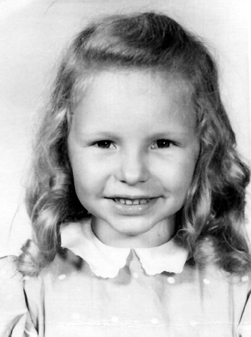
First grader

In our little town, there was no kindergarten, but I was reading and writing by the time I entered first grade. I was also talking. A lot. Miss Agnes Ray, who had taught my mother when she was in the first grade, got enough of me one day and spanked my hand with a ruler. In fairness I have to say she had warned me more than once. I still remember how my palm stung, but I remember even more how humiliated I felt. It wasn’t over then, either. My best friend told her mother, and her mother told mine, and the hole of trouble got deeper. I didn’t talk so much in class after that.

About that piano

I remember we went to Memphis to shop for pianos so Santa would know which one to bring. In the music store, I spotted a piano with a big red SOLD sign on it and our last name. You should have heard my parents talk their way out of that one, but it was similar to the way they explained the street-corner Santas. They were all Santa’s helpers, my dad said. Santa couldn’t be everywhere at once. That piano must have been delivered to Daddy’s store and hidden in the back part that was like a warehouse. How he (and whoever helped him) got it into the house on Christmas Eve without waking me up remains one of the great mysteries of my childhood. Bordering on miracle, that’s what it was. But then, you’d have to know my dad.

Plate-glass windows

Daddy hadn’t been in the parts business very long when I was six. I loved his store. It had two big plate-glass windows, a serious office-looking desk near the front, and against the wall, a bookkeeping desk where all the account files were kept, a file cabinet with a radio on top, and on the wall, a NAPA calendar featuring forties-type beauties (a little racy; I’m surprised my mother let him get away with that one), cold concrete floors, a big heater, a long counter for serving customers, and behind that counter rows of tall bins that held the automobile parts, hundreds of them. The store often smelled of motor oil or paint, but that didn’t bother me. I loved to play among the bins and pretend they were caves or secret passageways. There was something a little shivery about those dark tunnels, but I could always come out into the light, and Daddy (and often Mother, too) would be there.

Busy dad (note the receding hairline)

About the time I started school, my mother began “keeping the books” for the business. I spent many hours playing at that big desk by the window that looked out on the street. You wouldn’t think much happens in a little north Mississippi town with fewer than 2000 people, but you might be surprised. A lot of life moved past that window.

Going back

I went in that building a couple of years ago. It’s now an antique shop, the brick facade painted dark red. I didn’t want to go in, but my husband encouraged me to do it. “You never know what you might remember,” he said, and he was right. The place felt incredibly small. The bins were gone, of course, and the automobile smells, but the pressed tin ceiling was the same, and I would almost swear I smelled Daddy’s pipe tobacco and heard the ching of the cash register.

Here’s a bit of a poem, “Parts,” about that place and time:

The storefront faced west, the plate-glass window gilded

by the late sun’s angle, hiding what was inside:

The concrete floor stained black with motor oil that poured

like syrup in winter. Smells of paint, metal, rubber, tobacco.

The slide and ding of the cash register.

The tall bins rose, ominous and unsteady, toward the ceiling,

the aisles between them tunnels, their shelves heavy with parts:

spark plugs, carburetors, batteries, fan belts. I knew them all.

In this memory, the windows are spattered

with canned snow, Merry Christmas painted on backwards.

We are there together, my father, my mother, and I.

Through the plastic mist we watch the Christmas parade pass,

the band’s music thin and distant as the shabby Santa who lifts

his slow-motion mittened hand in our direction.

What places are most significant in your early memories? Have you had the opportunity to go back?

This post is part of the October Memoir and Backstory Blog Challenge launched by Jane Ann McLachlan. For previous posts, see Recent Posts in the right column.
If Mama’s Not Happy: A Sad Story

This is the fifth entry in Jane Ann McLachlan’s October Memoir and Backstory Blog Challenge.

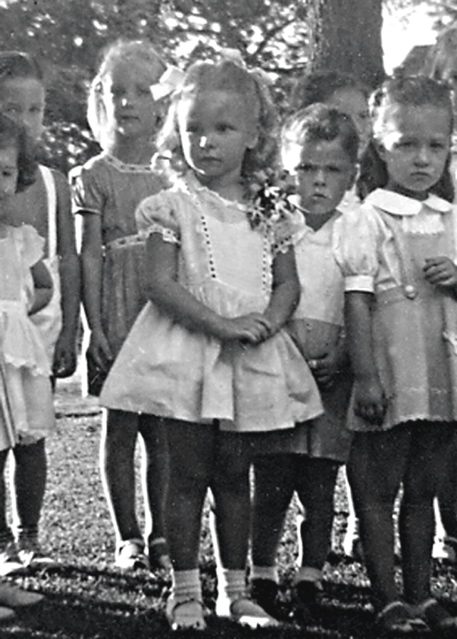
Fifth birthday

At my fifth birthday party

Nobody looks happy. That’s me in the middle, wearing the corsage of tuberoses.

The most striking memory from that time has made its way into my fiction. I must have been five, maybe six, when my mother bought a beautiful red suit. I don’t remember her trying it on, but I’m sure she must have modeled it for my father. She would have been so pretty wearing it. What I remember is her crying in the kitchen after he told her she’d have to take it back.

“We can’t afford it,” he said.

I was old enough to be distressed by my mother’s tears but not old enough to understand the complexity of love or the helplessness of witnessing someone else’s sadness.

My father had grown up during the depression. He had sold the service station by then and opened an automobile parts store. He went to work at six in the morning and came home at six at night, six days a week. He would have given my mother and me the world, if he could, but he saw that red suit as an extravagance. (It probably was.)

My mother did what he said. She took the red suit back.

Memory turns to story

That memory translated many years later into a short story set in the 1950s about a young farm wife who has had a stillborn child. The baby’s room has been cleared out, and her husband is at work on the farm all day. She goes into town to take some unused baby clothes back to the local store and sees a red dress in the store window. She uses the store credit to buy the dress.

Here’s a bit of “From This Distance,”* published in Arkansas Review some years ago:

Iris opens the box and unfolds the tissue. The silk dress isn’t fire engine red, but something different: maybe the color of maple leaves in late October. She lifts it out of the tissue and holds it up. Sunlight filters through it. She unbuttons her cotton dress and lets it drop to the floor, and the red dress floats down over her body like water. She can only see herself from the hips up in the mirror, but the dress looks fine. She feels pretty in it.  

That afternoon, she gathers fresh tomatoes, cucumbers, and onions from the garden and makes Peter’s favorite buttermilk dressing. She puts a ham in the oven to bake and makes bread, potato salad, and a lemon icebox pie. She sets the table in the dining room with their wedding china and puts a basket of daisies in the middle. Then she bathes, puts on a little makeup, dresses, and pins her hair up the way Peter likes it. By the time she hears him pull up to the barn on the tractor, she’s been ready and waiting for an hour. 

When Peter walks in, he slaps his keys on the kitchen counter, drops into a dinette chair, and rubs his hands over his face hard before he sees her standing there. He looks her up and down. “Where’d you get that dress?”

Iris smiles, but already she feels the stirring of what she’d felt in the yard that morning, that at any moment she might fly apart. “At Gordon’s,” she says. She smooths her hands down the front of the dress. 

Peter scrapes the chair back, goes to the refrigerator, and takes out a beer. He rummages through a drawer for the opener, tosses the top into the trash can under the sink, leans back against the counter, and takes a drink. All before he speaks. “How much did you pay for it?” 

She hasn’t thought about having to explain about the credit. 

Peter waggles the beer bottle at her. “Too much, I’d bet.”

“I don’t see what—”

“You’ll have to take it back. We can’t afford anything extra right now. Not until I see for sure what the crops are going to do. It’s too risky.” He drains the bottle and drops it in the trash can. “You know that.”

“I know, but I thought it would be nice if we—if I—fixed myself up a little. I thought—”

“Never mind what you thought. Go take it off before you get something on it and they won’t take it back. What do you need a red dress for? You can’t wear it to church. It’s cut too low.”           

Iris lowers herself into a chair, her heart pounding. This isn’t the way things are supposed to go. She fingers the skirt. So soft. Tears well up, and he sees. He walks over and pulls her up out of the chair and holds her. “I know you want it. Maybe next spring, you can buy yourself something special, but not now.” He lets her go. “I’m going to take a shower. Supper smells good.” He walks out of the room . . . 

She sits still for a minute, then stands up heavily and walks out of the kitchen, feeling more cumbersome than when she was pregnant.

My mother never saw any of my writing. I’d like to think it’s okay with her for me to use “her” material.

When were you first aware of someone else’s sadness or anger? How did it make you feel? Have you used that emotion in your writing? 

*If anyone is interested in reading all of “From This Distance,” you can find it atEBSCOhost (the Arkansas Review doesn’t maintain an online archive). I’m a little hesitant to recommend it to you since it was written a long time ago, and as I edited here, I found myself revising it!

Age Three: Some Life Lessons

A dress my mother made for me

When I was three years old, my paternal grandmother died just days before Christmas, almost a year to the day after her husband had died. What awful Christmases those must have been for my dad, but I never knew it. As I said earlier, I have no memory of my dad’s father. I don’t remember his mother, either, but I remember the wake. I remember being carried into that little house that felt close and hot (it was late December, after all) and seeing a big box placed against the back wall of the living room. The room was dimly lit, but there was no avoiding that box. My grandmother was inside it. I remember wondering why she was sleeping there. I didn’t associate her stillness with “dead.” I had never seen anything lifeless. I didn’t know what dead was.

I filed that image away in memory. Many years later, thinking maybe I had dreamed it, I finally asked my mother if she and Daddy had really taken me to the house after my grandmother died.

She looked at me sort of funny. “We did,” she said. “Why?”

“Well, I remember it.”

She shook her head. “That’s not possible. You were too little.”

“But I do.” I described the room and where the casket was placed against the wall and how it seemed like I was looking down at my grandmother.

“It’s because your daddy was holding you,” Mother said, looking stunned. “That would explain why you were looking down.” I don’t remember whether Mother asked me if I was afraid. I was later, with other deaths, but I did not see another dead person until I was ten years old.

“There was a little girl who had a little curl
Right in the middle of her forehead . . .”

An only child, by the time I was three, I was used to playing quietly by myself. I was a girly-baby doll kind of little girl. I had already begun to collect storybook dolls. Each time my dad went to Memphis on business, he brought me a “surprise”–sometimes a little doll (Bo Peep, Cinderella, Little Red Riding Hood . . .), sometimes something very special, like the rabbit fur hat and muff that made me sneeze. I loved pretty dresses. My mother was pretty, and I wanted to be pretty, too. (She did her part, rolling my hair in pin curls to try and tame it.)

I loved playing dress-up. I could make a playhouse out of anything–under the table, outside under the willow tree or even under a shrub!

Early morning dress-up time

About this time, the first thing I did every morning was put on a pair of my mother’s slingback heels and a hat and stash a big purse under my arm and head out to the garden. Never mind that I was still in my nightgown or that my hair was in pincurls. Nothing stopped me!

Meanwhile, in the house, there was sickness. But that’s a story for another day.

Maybe I was already learning to escape.

I still have some of those dolls, by the way. What childhood mementos do you have? What brings the memories back?