We Don’t Have to Know Everything

What do you do with someone who won’t behave?

This person is secretive, aloof, moody. She’s keeping me up nights and interfering with my novel-in- progress. She’s the character who “vants to be alone!”

Her name is Robin. She’s a twin. An accomplished photographer. She has dark hair and green eyes, she’s twenty pounds overweight, she’s married with two sons. Her marriage is in trouble. Her twin sister has died, and she carries a terrible secret.

All these complications in her life, and yet, even after excellent feedback at a workshop, I remain stumped by what Robin desires and what will keep her from getting it.

Photo: Andrew Seaman on Unsplash

So I start over at the beginning, revising as the story seems to lead me. I try applying a rubric the workshop leader shared. It’s a good tool to get a handle on what a story is about (can you say it in a sentence?), determine what the “container” is (time frame and place), and sketch out the main characters and plot points. The rubric helps, but I’m not there yet. I’m still worried about not knowing clearly who Robin is and where she’s going.

I have to confess I’ve never been big on plot points, but I’m learning. I tend to let the story evolve, which means I may do more work than someone who is able to plan the story (or book) out, start to finish. Sometimes, because of my tendency to “pantser” rather than plot, I feel inept as a writer.

Many writing experts contend that we should know everything we possibly can about a character before we begin. But a fine teacher of writing and an exceptional fiction writer in his own right, David Jauss, takes the stance that we don’t have to know everything. In fact, Jauss says it may be preferable not to know; not knowing every detail ahead of time may lead to richer character-ization as we discover things about characters as we write them.

What a relief!

What Jauss says doesn’t absolve me of all responsibility where the story is concerned. I can’t put the writing on automatic pilot. (Wouldn’t it be interesting if we could? But I don’t trust the recent developments in AI to do the job.) But Jauss’s take allows me the freedom to write about this character and her circumstances, to write into her, and see what unfolds. Maybe I’ll discover along with her how she ticks, where she’s headed, and how she’ll get there.

So here we go, my make-believe friend, Robin. Let’s see where the words on the page take both of us.

How do you handle your less-than-cooperative characters? Are you a “know everything” writer or one who goes with the flow?

Own the Emotion, Give It Away

Some years ago, I volunteered as a studio monitor during a regional ballet association festival. I watched nervously as the teacher pushed and corrected the young dancers, but I was happy to see how he also encouraged and praised. Toward the end of the session, he told the dancers something I’ve never forgotten: Technique isn’t enoughYou can be technically proficient, but without emotion, you’ll never be a true artist. He urged them to feel the music, to make their entire bodies expressions of emotion.

Credit: Samantha Hurley at Burst

I believe the same is true of writing. Artistry on the page isn’t only about skill or eloquence. We study and master craft; we may have a gift for language and storytelling; but if we can’t re-create emotion in ways that allow readers to feel, the prose will most likely be flat, no matter how well it’s written.

I learned a long time ago that my best work comes from an emotional place where I often would rather not be. So, when I become aware that a story isn’t working, I look hard for what I’m holding back.

There may be places we can never go in our fiction. I read once, though, that in one way or another, a fictional character will always be the writer.

One of the first stories I ever published gave me fits while I was writing it. The story dealt with betrayal, an experience I knew firsthand. Writing about that trauma was fraught with deep emotion, and yet I struggled to portray the feelings on the page in a way that didn’t feel stiff and superficial. A wise reader told me I was too close to the story; the protagonist was too much me. I needed to find a way to step back and give those emotions away. I was aware of the autobiographical elements, but I hadn’t realized how they were confining me. Instead of asking “What if…” I was locked into “This happened.” Once I changed the point of view, the story came pouring out. During the week it took to get the draft onto the page, I went upstairs every night after I stopped working, locked myself in the bathroom, and turned on the shower so my children couldn’t hear me crying.

Tapping painful experiences isn’t necessary for every story, and probing our personal stories isn’t right for every writer. There may be places we can never go in our fiction. I read once, though, that in one way or another, a fictional character will always be the writer, whether we intend it or not. It’s important that if we’re dealing with difficult feelings, we create distance. If we can manage that, if we can step back and at the same time go deep and open our hearts in the harsh light of the page, if we can mine our feelings that way, then the emotions that weigh us down can become genuine gifts of connection with our readers.

###

This post appeared on Telling Her Stories at Story Circle Network on October 21, 2022.

Story Surgery

A week or so ago, I re-read one of my short stories I hadn’t looked at in a while. I have to confess I’d felt a little smug about this one. (I almost never feel confident about what I write.) It’s unlike anything else I’ve written—a little edgy, playing around with POV and dialogue. Tight. Or so I thought. But I’d submitted it a few times with no luck–a sign the story isn’t necessarily bad, but it’s not as good as it could be.

I had never been truly satisfied with the ending, so I started there. I agonized. I lost sleep. I worked on the last two paragraphs for days (yes, sometimes that’s how long it takes), and finally, the ending seemed to gel. No small victory, that.

Then I read the entire story again—one last time, I told myself. I looked at white space, checked for typos. I had already read it for clichés, sentence variety, scene/narrative summary balance, tension, character arc/change, “flow” . . . If you’re a fiction writer, you know the drill. As I read, though, I realized the story was still heavy with gratuitous details and phrases, even whole sentences that didn’t contribute much.

Cutting Room Floor

"Possible Cut" by patpitchaya. Image courtesy of freedigitalphotos.net
“Possible Cut” by patpitchaya. Image courtesy of freedigitalphotos.net

So I started cutting. By the time I was done, the story was almost 500 words lighter. Tighter. Stronger. Why had it taken me so long to see what it needed?

Sometimes, time and distance give me perspective. I agree with the advice to “put it away for a while,” then reread with a sharp, critical eye. I often puzzle over a story for a long time before I figure out what it really needs. (Occasionally, I never figure it out, but that’s another post.)

Someone—surely more than one writer of advice on story craft—has said that nothing should go in the story that doesn’t advance it in some way. Nothing.

That, I believe, is the crux of revision whether you’re writing short or long fiction.

Ask yourself: Does this scene/ paragraph/dialogue/sentence/image/particular word (yes, word choice) move the story forward and/or grow the character? What does it add? Strike it out and read the passage aloud without it. See if you miss it, not because it was a brilliant turn of phrase but because without it, something absolutely essential has gone missing from the story. If not, cut. Cut. Cut. Painful, but necessary.

Be wary of language that calls attention to itself. In this story, I threw away a metaphor I loved. It was a beautiful image, but it didn’t do anything for the story. Sometimes we do indeed have to “kill our darlings.”

Granted, it’s possible to chop the life right out of a story. I know. I’ve done it. But sometimes, if we cut a story to its bones, we find a better way to tell it.

Before and After

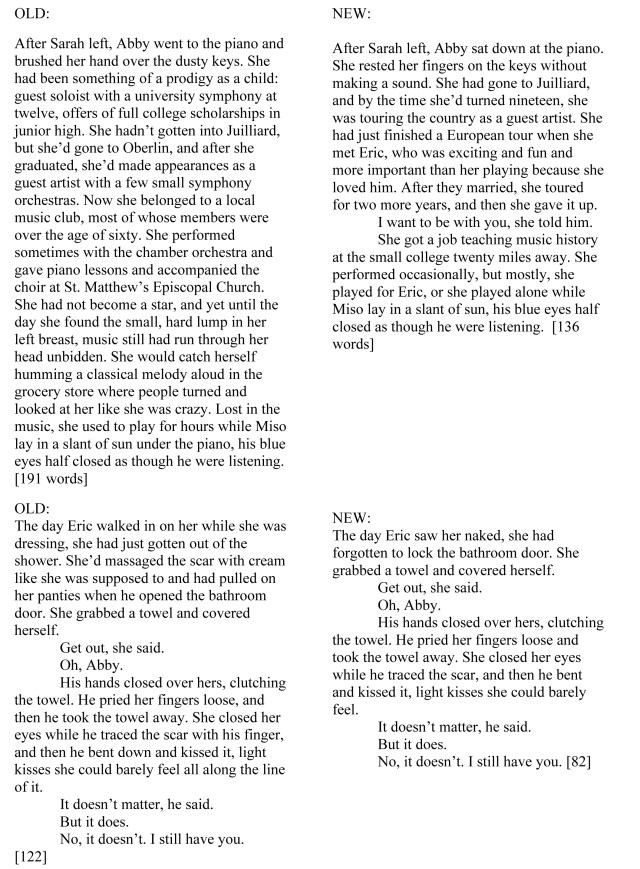
I want to share a couple of examples. This story, “Miracle of Doors,” is about a woman recovering from breast cancer. Out of context, these passages won’t mean much, but they illustrate the kind of cutting and refining I’m talking about. (Her cat, Miso, plays an important role in the story.)

Here they are, side by side:

Old_new_best.pdf
Before, after

This gives you an idea of my “tightening” process when I’m down to the last passes through a story. Sometimes it’s not the number of words but the words themselves that matter most. Maybe you’re able to write concisely or revise as you go. I tend to discover as I go; I write long drafts and whittle them down.

A story draft is the easy part. Revision is key to a polished piece of writing you can be proud of. Before you send the story out into the world: Refine. Make every word count!

Do you have favorite revision strategies? Share one with me!