Imagine (fiction)

Imagine

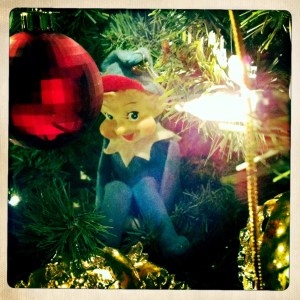
Maria’s husband, Jack, brings the elf out every Christmas and nestles it in the branches of the tree, like it’s hiding. Jack had this elf when he was a kid. Its green felt body and legs have faded. Its face is chipped. But its eyes are bright, and Maria feels it watching her from its perch, tucked back against the trunk of the tree.

Every time their two-year-old son, Eric, catches sight of it, he screams and runs to Maria.

“Take it off, Jack,” Maria says. “It scares Eric.”

Jack laughs. “It was my Christmas elf. I love this thing. He’ll love it, too. You’ll see.” Jack takes the elf out of the tree and starts toward Eric, who bursts into tears and reaches for Maria. She picks him up and he buries his face against her neck.

“Come to Daddy,” Jack says, but Eric clings to Maria, his arms tight around her neck. Jack plays peek-a-boo with the elf, pops it up behind Maria, hides it again. “Peek-a-boo!” Jack says in a high-pitched voice. “I see you!” Eric looks up, his face crumples. He howls.

“Stop it, Jack. Leave him alone.”

Jack looks, what, forlorn? “Okay, okay. But I’m putting it back on the tree.” He goes in the living room and Maria hears the tinkle of ornaments, moving.
Elf
Elf / Gerry Wilson

While Jack’s at work, Maria hides the elf in a drawer. “It’s gone, baby,” she tells Eric. “See?” But Eric still cries and refuses to go in the living room where the tree is. Maria is miffed. Jack’s ruining the first Christmas Eric might possibly remember.

It’s not just the elf, though. There’s something else, something bigger. Maria has read that men are sometimes jealous of their own babies. When women become mothers, they change. It’s hard being a mother and a wife.

When Maria and Jack agreed she would stay home for a couple of years after the baby came, Maria was glad. She hated the thought of leaving her baby in day care. Doing without her salary would be a sacrifice, but she could freelance from home, once the baby got a little older. And she has done that.

The trouble is, Jack comes in, kicks off his shoes, gets a beer, turns on the TV, drops on the couch, and doesn’t do a thing to help Maria. He plays with Eric, but mostly he gets the baby revved up so he has trouble going to sleep. Jack makes Maria’s job harder. And the sex—oh, God, it used to be so good. Now, most of the time, she’s too tired to think about it, but Jack won’t let her alone.

She can’t imagine her life without the baby. She can imagine it without Jack.

Most nights, Jack gets home late, after Eric is asleep. Maria puts the elf back on the tree before he comes in. The night before Christmas Eve, Jack says, “Where’s my elf?”

“Isn’t it on the tree?”

“You know it’s not, Maria. What’d you do with it?”

She shrugs. “I didn’t do anything. Maybe it fell. Did you look?” She goes back to the kitchen. Her heart is racing.

Jack is opening and closing cabinets and drawers. He yells, “This isn’t funny. Where’d you hide it?”

“I didn’t. Please be quiet. You’ll wake Eric.”

The elf made a smelly, smoky little fire in the back yard that morning while Eric was taking his nap. Maria burned it in an old metal garden bucket and scattered the ashes in a flowerbed, almost ceremoniously. The plastic face melted in the most grotesque way. She buried it. Only the jingle bell was left. She threw it over the fence.

Jack heads out the back door. She hears him rummaging through the trashcans. When he comes back inside, he’s flushed and winded. His eyes are unnaturally bright. Maria holds her breath until he stalks past her, through the kitchen, down the hall, into the living room. She imagines him looking at the blank space in the middle of the tree, looking deep into its branches, trying to see what isn’t there.
If Mama’s Not Happy: A Sad Story

This is the fifth entry in Jane Ann McLachlan’s October Memoir and Backstory Blog Challenge.

Fifth birthday

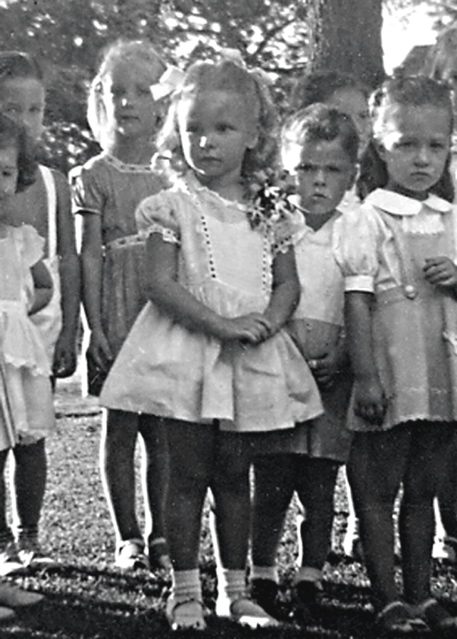
At my fifth birthday party

Nobody looks happy. That’s me in the middle, wearing the corsage of tuberoses.

The most striking memory from that time has made its way into my fiction. I must have been five, maybe six, when my mother bought a beautiful red suit. I don’t remember her trying it on, but I’m sure she must have modeled it for my father. She would have been so pretty wearing it. What I remember is her crying in the kitchen after he told her she’d have to take it back.

“We can’t afford it,” he said.

I was old enough to be distressed by my mother’s tears but not old enough to understand the complexity of love or the helplessness of witnessing someone else’s sadness.

My father had grown up during the depression. He had sold the service station by then and opened an automobile parts store. He went to work at six in the morning and came home at six at night, six days a week. He would have given my mother and me the world, if he could, but he saw that red suit as an extravagance. (It probably was.)

My mother did what he said. She took the red suit back.

Memory turns to story

That memory translated many years later into a short story set in the 1950s about a young farm wife who has had a stillborn child. The baby’s room has been cleared out, and her husband is at work on the farm all day. She goes into town to take some unused baby clothes back to the local store and sees a red dress in the store window. She uses the store credit to buy the dress.

Here’s a bit of “From This Distance,”* published in Arkansas Review some years ago:

Iris opens the box and unfolds the tissue. The silk dress isn’t fire engine red, but something different: maybe the color of maple leaves in late October. She lifts it out of the tissue and holds it up. Sunlight filters through it. She unbuttons her cotton dress and lets it drop to the floor, and the red dress floats down over her body like water. She can only see herself from the hips up in the mirror, but the dress looks fine. She feels pretty in it.  

That afternoon, she gathers fresh tomatoes, cucumbers, and onions from the garden and makes Peter’s favorite buttermilk dressing. She puts a ham in the oven to bake and makes bread, potato salad, and a lemon icebox pie. She sets the table in the dining room with their wedding china and puts a basket of daisies in the middle. Then she bathes, puts on a little makeup, dresses, and pins her hair up the way Peter likes it. By the time she hears him pull up to the barn on the tractor, she’s been ready and waiting for an hour. 

When Peter walks in, he slaps his keys on the kitchen counter, drops into a dinette chair, and rubs his hands over his face hard before he sees her standing there. He looks her up and down. “Where’d you get that dress?”

Iris smiles, but already she feels the stirring of what she’d felt in the yard that morning, that at any moment she might fly apart. “At Gordon’s,” she says. She smooths her hands down the front of the dress. 

Peter scrapes the chair back, goes to the refrigerator, and takes out a beer. He rummages through a drawer for the opener, tosses the top into the trash can under the sink, leans back against the counter, and takes a drink. All before he speaks. “How much did you pay for it?” 

She hasn’t thought about having to explain about the credit. 

Peter waggles the beer bottle at her. “Too much, I’d bet.”

“I don’t see what—”

“You’ll have to take it back. We can’t afford anything extra right now. Not until I see for sure what the crops are going to do. It’s too risky.” He drains the bottle and drops it in the trash can. “You know that.”

“I know, but I thought it would be nice if we—if I—fixed myself up a little. I thought—”

“Never mind what you thought. Go take it off before you get something on it and they won’t take it back. What do you need a red dress for? You can’t wear it to church. It’s cut too low.”           

Iris lowers herself into a chair, her heart pounding. This isn’t the way things are supposed to go. She fingers the skirt. So soft. Tears well up, and he sees. He walks over and pulls her up out of the chair and holds her. “I know you want it. Maybe next spring, you can buy yourself something special, but not now.” He lets her go. “I’m going to take a shower. Supper smells good.” He walks out of the room . . . 

She sits still for a minute, then stands up heavily and walks out of the kitchen, feeling more cumbersome than when she was pregnant.

My mother never saw any of my writing. I’d like to think it’s okay with her for me to use “her” material.

When were you first aware of someone else’s sadness or anger? How did it make you feel? Have you used that emotion in your writing? 

*If anyone is interested in reading all of “From This Distance,” you can find it atEBSCOhost (the Arkansas Review doesn’t maintain an online archive). I’m a little hesitant to recommend it to you since it was written a long time ago, and as I edited here, I found myself revising it!

Count No-Count, Mr. Bill, Pappy . . .

Bookshelf

Today marks the fiftieth anniversary of William Faulkner‘s death on July 6, 1962. So why, you may ask, would I write about an author who’s been dead for fifty years?

Here’s why:

I grew up thirty miles from Oxford, Mississippi, practically in Mr. Faulkner’s shadow. I vaguely remember the hoopla when Intruder in the Dust was filmed there (that’s a very early memory, mind you). The locals didn’t think much of him; they called him “Count No-Count,” apparently a reference to his laziness. His views, not to mention his often difficult, convoluted prose, didn’t cut it with the home folks back then.

Maturity Required

In college, I was forced to read Faulkner. Not until I was in my forties did I decide to have another go at his novels. One summer, I read The Sound and the Fury, Absalom, Absalom!, Sanctuary, and Light in August in quick succession. Once I immersed myself in the language and the rhythm of the prose, it became less difficult, even mesmerizing. If you’re not a Faulkner fan, I know I probably won’t convince you to take him on. All I’m saying is that it took a certain maturity on my part, both in terms of life experience and as a reader, to appreciate him.

Later, I wound up teaching The Unvanquished and As I Lay Dying to high school students (I struggled to get As I Lay Dying on the reading list–too hard, other teachers said). Many of the kids responded well to a close reading of those books. There’s also an element of pride, I would tell them; Mississippi may be last in a lot of things, but we’ve produced some fine writers, and William Faulkner is arguably among the best. Ever. Anywhere.

Bring On Mr. Bill!

If you’ve never read Faulkner, think about taking him on. The Unvanquished is a portrayal of life (on the Southern side) during the Civil War. It’s an easy read compared to most of his other books, but it’s not “typical” Faulkner in terms of style. Try As I Lay Dying, which is a manageable read and a remarkable book. Then work your way up–maybe Light in August or Absalom, Absalom! Tackle Sanctuary (possibly his most controversial work), or The Sound and the Fury; its first section is written in the consciousness of Benjy, a grown man with the mind of a child who has no perception of chronological time. Someone–I don’t remember who–recommends you read the rest of the book first; then go back and read the Benjy section, and it’ll be more accessible.

There are many others. These are just my favorites.

If you’re not up for tackling a novel, start with a short story: “That Evening Sun” or “A Rose for Emily” or “Barn Burning.” But whatever you do, read some of Mr. Bill’s work, especially if you never have. (You can find the full text of these stories online.)

Faulkner = Home

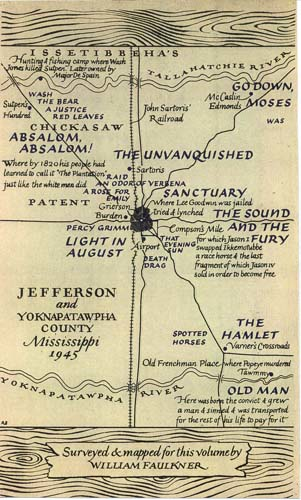
William Faulkner. [Map of Yoknapatawpha County] from The Portable Faulkner (New York: The Viking Press, 1946).

Maybe I relate to Mr. Bill’s work because it resonates of home. I recognize Yoknapatawpha County, those hills, that hard red earth, the people. Not everybody has those ties, but you don’t really need them. Faulkner’s work has withstood the test of time for a reason. Go there. You’ll recognize someone.

Here’s a recent article you might find interesting: How William Faulkner Tackled Race — and Freed the South From Itself. And if you’re curious about the man, go to William Faulkner: Frequently Asked Questions.

I’m well aware that people tend either to love or hate Faulkner! Where are you on that continuum? What have you read?