Story Surgery

A week or so ago, I re-read one of my short stories I hadn’t looked at in a while. I have to confess I’d felt a little smug about this one. (I almost never feel confident about what I write.) It’s unlike anything else I’ve written—a little edgy, playing around with POV and dialogue. Tight. Or so I thought. But I’d submitted it a few times with no luck–a sign the story isn’t necessarily bad, but it’s not as good as it could be.

I had never been truly satisfied with the ending, so I started there. I agonized. I lost sleep. I worked on the last two paragraphs for days (yes, sometimes that’s how long it takes), and finally, the ending seemed to gel. No small victory, that.

Then I read the entire story again—one last time, I told myself. I looked at white space, checked for typos. I had already read it for clichés, sentence variety, scene/narrative summary balance, tension, character arc/change, “flow” . . . If you’re a fiction writer, you know the drill. As I read, though, I realized the story was still heavy with gratuitous details and phrases, even whole sentences that didn’t contribute much.

Cutting Room Floor

"Possible Cut" by patpitchaya. Image courtesy of freedigitalphotos.net
“Possible Cut” by patpitchaya. Image courtesy of freedigitalphotos.net

So I started cutting. By the time I was done, the story was almost 500 words lighter. Tighter. Stronger. Why had it taken me so long to see what it needed?

Sometimes, time and distance give me perspective. I agree with the advice to “put it away for a while,” then reread with a sharp, critical eye. I often puzzle over a story for a long time before I figure out what it really needs. (Occasionally, I never figure it out, but that’s another post.)

Someone—surely more than one writer of advice on story craft—has said that nothing should go in the story that doesn’t advance it in some way. Nothing.

That, I believe, is the crux of revision whether you’re writing short or long fiction.

Ask yourself: Does this scene/ paragraph/dialogue/sentence/image/particular word (yes, word choice) move the story forward and/or grow the character? What does it add? Strike it out and read the passage aloud without it. See if you miss it, not because it was a brilliant turn of phrase but because without it, something absolutely essential has gone missing from the story. If not, cut. Cut. Cut. Painful, but necessary.

Be wary of language that calls attention to itself. In this story, I threw away a metaphor I loved. It was a beautiful image, but it didn’t do anything for the story. Sometimes we do indeed have to “kill our darlings.”

Granted, it’s possible to chop the life right out of a story. I know. I’ve done it. But sometimes, if we cut a story to its bones, we find a better way to tell it.

Before and After

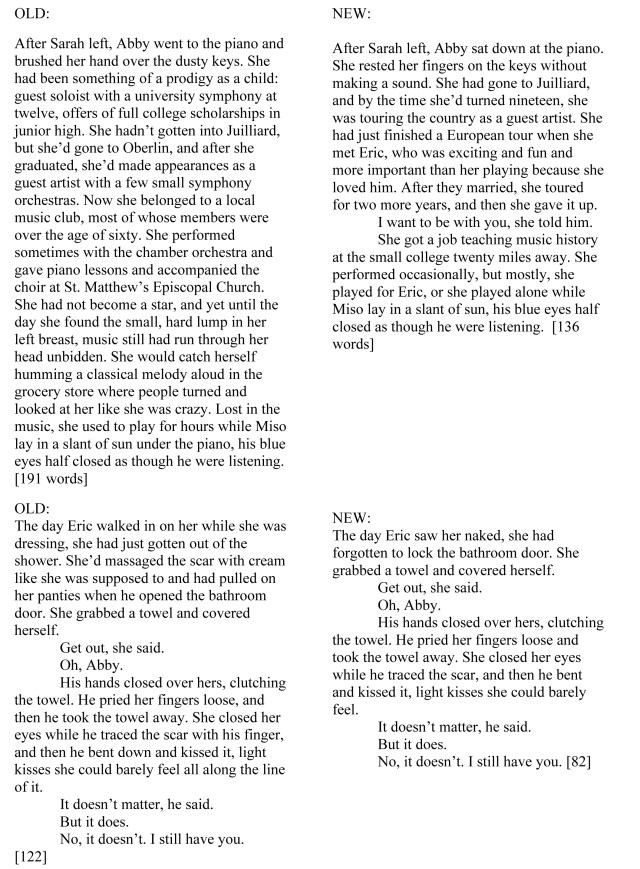
I want to share a couple of examples. This story, “Miracle of Doors,” is about a woman recovering from breast cancer. Out of context, these passages won’t mean much, but they illustrate the kind of cutting and refining I’m talking about. (Her cat, Miso, plays an important role in the story.)

Here they are, side by side:
Old_new_best.pdf
Before, after

This gives you an idea of my “tightening” process when I’m down to the last passes through a story. Sometimes it’s not the number of words but the words themselves that matter most. Maybe you’re able to write concisely or revise as you go. I tend to discover as I go; I write long drafts and whittle them down.

A story draft is the easy part. Revision is key to a polished piece of writing you can be proud of. Before you send the story out into the world: Refine. Make every word count!

Do you have favorite revision strategies? Share one with me!

Hair Today—Gone Tomorrow?

When my husband needs a haircut, he says, “I think I’ll go get a haircut.” He breezes out the door and is back in an hour.

For me it’s a life-altering decision.

When I’m dissatisfied with my hair, it colors my entire life (pun intended). Bad hair puts me in a mood to match. So, back in the fall, when the haircuts weren’t working, they left me in a perpetual state of agitation.

But oh, change is tough. A woman develops loyalty to whoever puts scissors to her hair, let alone colors it, and rightfully so. Talk about trust issues. When the time comes for a change, it feels like betrayal. Just asking my friends for recommendations or browsing the yellow pages or scouting salons online felt like I was sneaking around.

Drastic measures

Changing hairdressers requires much soul-searching and justification, tallying grievances that make a drastic move not only desirable but also necessary. Here are a few of mine:

  • S/he cut it too short.
  • S/he didn’t cut it short enough.
  • S/he was running late.
  • S/he was distracted.
  • S/he talked too much.
  • S/he didn’t listen to what I said I wanted.

And so, after agonizing for weeks and then acting on a whim (if I didn’t act on a whim I would never, ever pick up the phone), I called a hair stylist a friend had recommended. I figured it would be weeks before I could get in, but NO. He had an opening the following Saturday. “Noon,” he said.

“Noon?” I repeated, stupidly.

“Yes. Noon.”

“I’ll take it,” I said.

For two nights before that appointment, I had nightmares about haircuts gone bad. I vacillated between guilt and terror. What had I done? Well, I had betrayed a perfectly good hair stylist, that’s what.

It’s only hair.           

When Saturday came, armed with my photo of Helen Mirren with short hair, I set out. I gripped the steering wheel hard. I had sweaty palms. It felt like a trip to the dentist. I told myself, it’s only hair. 

The salon was small and quiet, only a couple of customers on Saturday at noon. I tried to appear nonchalant, like someone who tries out a new hair stylist every other month or so, but I must have been ashen because the stylist zeroed right in on my case of nerves.

“It’s going to be okay,” s/he said, like a parent reassuring a kid with a skinned knee.

I considered bolting, but I didn’t. I wondered, sitting there, waiting, why haircuts make me so nervous. And then I remembered.

The monstrous machine

The Bad Perm
The Bad Perm

When I was a little girl, I had really pretty hair. In most photographs, it’s shiny and clean and nicely curled, usually with a big bow. But my mother must have gotten tired of taking care of it. That’s the only explanation I can fathom for why, when I was three, maybe going on four, she took me to the beauty parlor over the drugstore, up the same stairs to where the doctor’s office was. I had been in that beauty shop before with my mother. Somebody had probably trimmed my hair. I’d seen women sit under the permanent wave machine, a monster of a thing with long tentacles that attached to their heads. I’d never dreamed it could happen to me, but that day, it did. My mother apparently wanted my hair short and carefree. Somebody cut my long hair off, and then I sat under that machine, breathing in the awful permanent wave solution fumes, those fumes and fear and humiliation making me cry.

I remember that, when we got home, I refused to look in the mirror. I don’t remember ever looking, although at some point I must have. I couldn’t have avoided mirrors for the long time it took for the awful frizzy perm to grow out. You can see for yourselves in the photo how bad it was. 

What possessed my mother? I have no idea. Whatever it was, she must have felt guilty because by my fifth birthday, my hair was long again, and pretty.

Back to the present

Of course, the encounter with the new stylist wasn’t perfect, either. There were a few problems:

  • S/he was running late.
  • S/he cut it too short.
  • S/he talked too much.
  • S/he didn’t listen to what I said I wanted.

I’ll stick with this stylist for a while, though. After all, I’ve made the break, and making up is just too hard. I’ve already gone back a second time, and this time, I let this new person, this person I hardly know, color my hair. Now that, my friends, is trust. And, would you believe—I like it!

Do you have hair horror stories? If so, share them here!

The reason “pantsing” is so easy to embrace…

The reason “pantsing” is so easy to embrace might be because it’s kind of like eating Tater Tots and watching Duck Dynasty. It’s much easier to “let ‘er rip” in the hope that a story “will magically appear” than it is to dig down into what you’re trying to say, and create the clay from which the story itself will be built.

Lisa Cron in “A Modest Proposal to Pantsers: Don’t!” at Writer Unboxed. I stand convicted!