I Refuse to Call This “Sweet Sixteen”

Although I was. Sweet, that is. Innocent, really. Had never been kissed, until my sixteenth birthday. Really.

My mother had given me a pamphlet called “What Every Girl Should Know,” a kind of watered-down version of the facts of life. We had never had “the talk.” My grandmother told me to “keep my skirts down” (she told me that after I divorced at forty, too). About this time, a girlfriend and I took one of her father’s medical textbooks down from the shelf one day and greedily read the facts. I was partly astonished, partly appalled. And during my junior year, this year called sixteen, another friend dropped out of school, pregnant. She would never go back.

Meanwhile, I went on my merry little innocent but angst-ridden way.

This diary should be burned.  It’s solid evidence that I must have been the silliest sixteen-year-old who ever lived.

Diary. To be burned.

I was silly-sick in love with a boy who knew I had a crush on him, and he played me like crazy.  He would put the word out that he was going to ask me for a date for something big–like the Junior-Senior Banquet–and then he’d wait until the very last minute to ask. I was oohing and ahhing and Dear Diary-ing, page after page about how he called or he didn’t call. Meanwhile, I seemed to be having a pretty good time! I had great girlfriends, although my best friend would move away at the end of that school year, and I would never see her again. I was dating at least one other boy, and there was a lot of driving around in cars and meeting up with boys at the Dairy Bar and going to movies and meeting up with boys there.

But this one boy who mattered to me more than the others–he could be loving one day and cruel the next. Looking back, I believe he introduced me to emotional abuse, only I didn’t know what to call it. It was good practice for later, I suppose. If I had understood it better, I would have realized that I was pretty and smart and talented, and he was good looking and not smart and very insecure. The only way he could be with me was to put me down. Sad, isn’t it, that I took that for two years. In my defense, I was only sixteen, and back then, sixteen was very young.

Here’s a quote from the diary: I will never understand boys or men! That about says it, doesn’t it?

Tell-tale words

When you close your eyes and look at your young self, what do you see? 

Age Fifteen: “Where the Boys Are . . .”

After the so-called senior recitalwhich should have marked an end point, should it not?—the piano saga continued.

I played in a piano competition in Memphis the fall I turned fifteen. I was the youngest competitor, which should have told me something. Also, I’d refused to practice as I should. I went blank in the performance, just lost it several measures in. I started over and played fairly well, but the damage was done. I was humiliated.

My teacher for nearly ten years didn’t feel she had anything else to offer me, so my mother dragged me once a week to a nearby small college where I fumed for an hour under the tutelage of a young piano professor who forced me to play Bartok. I hated every minute. I had better things to do now. Those lessons lasted an interminable year.

Oh, but that summer!

By this time, my parents invited my best friend to go along on our beach trips. We usually stayed at Panama City Beach, in motels with names like Trade Winds and Surf and Sand. One year, we could see the amusement park just down the beach. We could walk there. (Chaperoned, of course.)

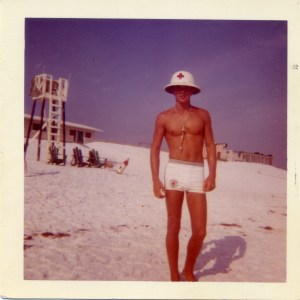
Here we are, prepping for the beach. And the second photo shows you what we found: a lifeguard. Cute, isn’t he? And he was mine!

Friend Sarah and I check out the beach. I’m on the left.

Lifeguard!

He had a friend, too, for my friend, which worked out nicely. We mostly talked to these boys when they were off duty during the day, but one evening, my folks allowed us to invite the boys up to the motel (my parents had to meet them, of course), and then we were allowed to sit around the pool and walk on the beach. I don’t remember this boy’s name. I never saw him again. But it was heady stuff.

I had gone from little girl a year before to full-fledged teenager. Still no dates. Still no kisses. But I was on my way!

That friend, by the way, is still around. She and I don’t talk or write often, but when we do, it’s as though we pick up where we left off. Occasionally, she’ll send me a photo from when we were girls together. I do the same. Friendships like that, and memories of beaches and lifeguards, don’t fade with time.

Is there a particular place you associate with the time when you went from child to teen? A particular friend or experience? Tell me about it!

This is the fifteenth post in the October Memoir and Backstory Blog Challenge. Thanks, Jane Ann McLachlan, for the challenge.

Age Fourteen: Not There Yet

In terms of maturity, that is, in every sense of the word.

The photo? Another beach trip. Note that the legs are getting longer, but I still look like a child. Love the car, though.

Beach motor hotel, the fifties

I was, however, a mature pianist. I gave a “senior” recital in October after I’d turned fourteen in September. They even trotted out the high school glee club for this one. It was quite a deal. And then it was over. I didn’t want to take piano any longer. What was the point?

The event of the year was a non-event, actually. (I’m fudging a little in order to write about it, but did happen during my fourteenth year.) Had I gone that night, it might have been one of the most memorable of my life. A young singer from Memphis named Elvis Presley was set to play at the Toccopola, Mississippi, gymnasium on March 29, 1955. (Toccopola was, as we’d say, way out in the county. This was not a major tour. Elvis was just getting his swivel going.) I begged to go, oh, how I begged, but my parents said no. So I missed seeing ELVIS IN PERSON, before he hit it really big.

I have fictionalized that night in a long poem. The venue is no longer a high school gym but a roadhouse. Makes it more interesting, I think. In the poem, not only do I go to see Elvis, but my parents . . . Well, you’ll see.

This edited section picks up in the middle:

Summer Nights Like This

. . . and there he was—Elvis,

not yet the King—

just a fresh-faced, pouty-mouthed

kid from Tupelo with a rag-tag band

and the longest sideburns

I’d ever seen. He sang

“I don’t care if the sun don’t shine,

get my lovin’ in the evenin’ time”

and the crowd was dancing

and screaming and I was screaming

and the back of my neck prickled

like a ghost had run a finger

across it

and it made me turn and look

and there, across the room,

I saw my mother and daddy dancing . . .

They did the bop better than any of us kids.

When had they practiced their twirls and turns,

their dips and swaying hips?

When the song ended, even Elvis applauded,

but I looked away. I could not bear

my mother’s beauty,

the wild suggestion of my daddy’s touch:

I began to cry,

not for fear of being caught

but because I imagined them young,

I imagined them lovers on summer nights

like this, her naked skin against his,

with all the mysteries I had yet to learn

before them still.