The Sisters’ Story

Enter a room with four elderly women–all in their nineties–in various stages of infirmity and alertness. They are sisters, and all of them grew up with my mother in a small town in north Mississippi. This means they were all born within a few years of 1920. They were girls during the Great Depression, young women around the time of World War II. I’m visiting with them just before Thanksgiving. They are having a grand reunion, and I’m grateful to be included for a little while.

I have driven to the family farm on a gorgeous late fall day, caught up in my own memories, a little apprehensive, not sure what to expect. One of the sisters, the one I see frequently and have stayed most connected with over the years, has Alzheimer’s and is declining. I’m relieved to see that the others–Julia, Eleanor, Genevieve (what beautiful names!)–are in fair shape physically, considering their advanced age, and their minds seem reasonably sharp. They all exclaim over me and say I’m the image of my mother.

Eleanor is exactly the age my mother would be. They were very best friends growing up and throughout my mother’s life. With some difficulty Eleanor stands when I walk in the room, comes to me, and hugs me hard. In spite of her age and having suffered a broken hip a few years ago, she stands straight and tall, but she feels fragile in my arms. I can still see the Eleanor of fifty years ago in her features. When we sit on the couch together, she takes my hand and holds on tightly.

Stories

Over the course of the afternoon, Eleanor tells me many times that she and mother walked to school together “from the fourth grade on.” I wonder how that was possible since they lived across town from each other, but I don’t ask. I have brought photos of Eleanor and of my mother and dad, hoping to jog her memory, hoping for stories. She talks about how beautiful my mother was and describes in detail a blouse Mother wore about the time she and my dad married. “It had a beautiful, pleated collar that framed her face,” Eleanor says. Remarkably, she has described the blouse in the photo below. Mother would have worn it around 1940, more than seventy years ago.

My mother, about age twenty

My mother died in 1985, and I never see Eleanor that she doesn’t tell me that she still misses her. But Eleanor’s stories are changing. She tells me she has letters Mother wrote to her about my dad when they were first dating. The last time I talked with Eleanor, the letters were about Mother’s pregnancy with me. I’ve never seen them. I’m not sure they exist any longer. The topic of letters reminds me that these women went off to college, and my mother did not. I wonder how painful it was for Mother to be left behind. Of course, if she had gone away, she wouldn’t have met my father when she did. They might never have met. She might have had an entirely different life. I wouldn’t exist.

Recognition

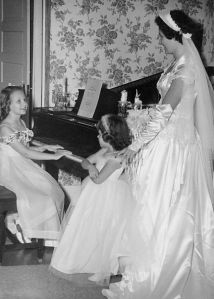
One of the other sisters says, “You played at my wedding reception!” It’s true. There’s a photo to prove it: Genevieve in her beautiful wedding dress, standing beside me at the piano. I was ten. Today, she has a lovely, serene face. She chats and smiles. But when it’s time to go to the table, her daughters lift and carry her.
Reception
Reception

During lunch I sit next to Eleanor. There is lively conversation, but she’s quiet. After lunch, a couple of the sisters doze in their chairs. “When are you coming to see me?” Eleanor asks. “Will it be soon? Will it be December?” I say I’m not sure, already feeling guilty, thinking about all the reasons I should go and all the reasons not to. They aren’t valid excuses. What better way could I spend my time during the holidays than to take a day–just one–and go and visit her?

Leaving

When it’s time for me to leave, I’m filled with sadness. I wonder about the memories and stories my mother might have contributed had she been here. I think about how, when I laugh, it’s my mother’s voice I hear.

Eleanor insists on getting up from the couch and following me to the door on her walker. She stands in the doorway and waves as I’m driving away. My last glimpse of the farmhouse, she’s still there at the door. I wonder what she’s thinking. My eyes fill with tears. I hate to leave her especially, not knowing whether I’ll ever see her again.

I’m overwhelmed by such an accumulation of life and memories and years gathered in that house. I’m struck, as I am so often now, by how stories change over time. I’m sure my own stories are changing, but what time robs from us it also invents, as long as we keep telling.

Are  you “in between” the very young and the very old? What are you doing to preserve the stories?

Age Twenty-five: The Turning Point

So we come to the end of the October Memoir and Backstory Blog ChallengeThanks to Jane Ann McLachlan for proposing this challenge that has taken me places in memory where I would never have gone otherwise. At times I believed I’d have nothing to write, but it seems memory begets memory.

The end of the challenge brings me to a strange place in my personal history. If you’ve been following these posts, you know that by the time I turned twenty-five, I had two little boys. I was a stay-at-home mom. I couldn’t imagine a different kind of life. I was happy. I thought we were happy.

Christmas

Our first Christmas in the little gray house, my husband and I decided to have a party. I cooked all the food, I cleaned, and I decorated, using lots of freshly cut evergreens and magnolia my parents brought the day before. They took both babies home with them, so we would have our party and the rest of the weekend to ourselves. It was a rare occasion. My husband was in his internship year by then, which meant more nights on call, more time away from home.

We had a great crowd, mostly medical school friends, good food, good wine. I wore a new dress, and I remember feeling pretty. After the last guests left, we stayed up late, picking up glasses, cleaning up spills, putting away food. I was excited and pleased at how well the party had gone, and I kept trying to get some kind of response out of him. I wanted to be told what a good job I’d done. I had done it for him, after all. But I got nothing. He had seemed withdrawn and sad for weeks. Every time I’d asked, he would say he was exhausted, which was true. His schedule was grueling. But I kept after him that night until he told me. Yes, there was something wrong. He wasn’t sure he loved me, he said. Maybe he loved somebody else. What? We had been married three years. We had two children.

I didn’t sleep that night. The next morning, he got up early and went hunting with friends–another surprise. He hadn’t told me he was going. I was left alone, distraught and uncertain. I missed my children. I called my parents, thinking I would just check on the kids, and my mother immediately knew something was wrong. I told her. I’ve always regretted that.

By the time my husband came home the following afternoon, the little boys were back, too. He had made his decision, he said. He wanted us. Just like that. That easily. And I believed him.

We would stay together for a long time after that Christmas. I gave birth to two more sons. Did I think that having more children would hold him? No. I’d wanted a house full of children, remember? It didn’t matter. He left anyway.

I blamed myself. He was the one who left, but it must have been my fault. All my fairy-tale notions of love and marriage? Destroyed. I hated myself for not knowing what I might have done differently. Oh, I knew all the self-talk and the psychology. I was a psych major, after all. I went for counseling. But still, it was a long time before I could look anybody in the eye and carry on a conversation.

I wasn’t writing back then, but I was getting ready. I believe the surprises, the unexpected turns, the complexities of relationships, the betrayals, the losses, the long years of trying to hold a marriage together, of getting up in the morning and putting on a fictional face to the world (“How are you?” “I’m fine, thank you!”), were the catalysts for stories to come.

I hope stories will surface out of this challenge. We shall see.

Thanks to all of you who have read and followed these little pieces of my past. I hope you’ll come back soon and see what else I have in store. Or in story.

If you participated in the challenge, what did you gain from it? If you were a reader and/or follower, what have these memories sparked for you?

The Not-Eleven Memoir: The Star!

This post should be about age eleven, but I’m breaking the rules of the October Memoir and Backstory Blog Challenge. It turns out that the year after I turned ten (it’s my eleventh year, after all, so maybe that counts for something) was a big one in terms of memorable events. The ice storm. My grandfather’s death. But it was also the solo recital year, and I have to write about that.

First, a little music history: I had started piano lessons the summer before I turned six with a college student who had allowed me to “play by the numbers.” When my real teacher, Miss Vera, took me on in the fall, I didn’t know one note from another, so she started over. If you’ve been reading these posts, you know about the piano Santa brought. Daddy played some by ear, and I was picking out tunes before I started lessons. In that house, we loved music! There were the radio shows my parents listened to, but they didn’t own a record player until later. By the time I was seven or eight, I did. Among my favorite records–all 78s–were Peter and the Wolf and Rusty in Orchestraville (a narrative that introduced all the instruments of the orchestra). There were others, I’m sure. I took to the piano and I had a good ear, which helps account for “learning ” music without being able to read it.

The first recital dress my mother made

But I progressed. For my very first piano recital, my mother made a dress: pale blue organdy with triangles of ruffles on the skirt and a band of ruffles across the shoulders. At the point of each of those ruffled inserts on the skirt was a rosette of tiny organdy rosebuds tied with narrow satin ribbon, like nosegays, all made by hand. I remember watching Mother make them; those rosebuds involved a tedious process of rolling the edges of the fabric between her fingers. What a labor of love that dress was, and how I wish she hadn’t let someone borrow it! We never got it back.

The ruffles around the neck are obvious in the photo, and if you look carefully, you can see the top of the ruffles on the skirt.

Solo recital

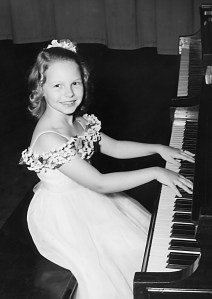
When I was ten (going on eleven by a few days), I gave a solo recital. That’s right. All by myself. An older boy played a duet with me (a boy who was teased unmercifully for his talent and his “sissy” ways), and Miss Vera herself played second piano on a rousing arrangement of “Turkey in the Straw.” I was a hit, and I would continue piano lessons through the ninth grade. This recital dress was pale pink, by the way. And those are tiny artificial flowers sewn on by hand. My mother didn’t consider herself to be creative, but I believe she was an artist.

What music do you remember? Did you learn to play an instrument? Did you love it or hate it?