Open the Doors. Walk Right In!

We talked recently about the importance of ridding a story of whatever isn’t absolutely necessary and/or doesn’t advance the story. This “excess” can be anything from losing a line of description to cutting out a character. Or a scene. In the case of novels, entire chapters.

But once we’ve reduced a story to its bare bones, what’s next?

We look for opportunities.

A few years ago, in a fiction workshop at The Lighthouse Lit Fest in Denver, I had the opportunity to sit down with an author I admired to talk about the opening pages of my novel. That hour was golden, but it was also hard. What I’d thought was a pretty good start had lots of growing to do.

Image: Jan Tenneberg, Unsplash

Most of his comments—scrawled in the margins beside a line or two of underlined text—said simply “Open this door.” He talked about being alert to a range of possibilities to go deeper into a character’s psyche, to make description more visual and significant to the story, to open up the plot in a different direction.  

How was it he could see those things when I had not? I’ve decided it’s a skill that comes with practice.

As you read through a draft (preferably aloud), be open to possibilities. Be aware of anything that needles you, of passages that feel somehow incomplete or “off,” of words or phrases that nag you. In my experience, sometimes there’s only a vague uneasiness; I can’t say right away “what’s wrong.” It can feel so urgent to “finish” and get a story out into the world that it’s easy to ignore these signs. Chances are, they won’t go away on their own. And the story won’t fix itself.

Here’s an example of what I mean by opening doors, taken from a story I’m still working on, “Fast”:

Paul witnessed his father’s hard life as the pastor of two, sometimes three rural churches at a time. His shortest tenure while Paul was growing up was two years, the longest ten; a cycle that repeated throughout his father’s life.

Became this:

Whenever someone asks how he came to be a minister, Paul likes to say he was called. It’s what his father said, and Paul believed it. Why else would a man choose to serve two, sometimes three poor, rural congregations at once, moving every few years to a different set of churches, a different set of people and problems? Paul witnessed the toll it took—never enough energy or time to go around, never enough money. Paul was eighteen and about to leave for college when his father told him he had one piece of advice. He swept his arm around the shabby office in one of those rural churches. “Whatever you do, don’t do this,” he said.

What’s the difference—beyond more words?

What works for you when it comes to “fleshing out” stories? I would love to see your comments.

[This post originally appeared at Story Circle Network, February 10, 2023.]

Story Surgery

A week or so ago, I re-read one of my short stories I hadn’t looked at in a while. I have to confess I’d felt a little smug about this one. (I almost never feel confident about what I write.) It’s unlike anything else I’ve written—a little edgy, playing around with POV and dialogue. Tight. Or so I thought. But I’d submitted it a few times with no luck–a sign the story isn’t necessarily bad, but it’s not as good as it could be.

I had never been truly satisfied with the ending, so I started there. I agonized. I lost sleep. I worked on the last two paragraphs for days (yes, sometimes that’s how long it takes), and finally, the ending seemed to gel. No small victory, that.

Then I read the entire story again—one last time, I told myself. I looked at white space, checked for typos. I had already read it for clichés, sentence variety, scene/narrative summary balance, tension, character arc/change, “flow” . . . If you’re a fiction writer, you know the drill. As I read, though, I realized the story was still heavy with gratuitous details and phrases, even whole sentences that didn’t contribute much.

Cutting Room Floor

"Possible Cut" by patpitchaya. Image courtesy of freedigitalphotos.net
“Possible Cut” by patpitchaya. Image courtesy of freedigitalphotos.net

So I started cutting. By the time I was done, the story was almost 500 words lighter. Tighter. Stronger. Why had it taken me so long to see what it needed?

Sometimes, time and distance give me perspective. I agree with the advice to “put it away for a while,” then reread with a sharp, critical eye. I often puzzle over a story for a long time before I figure out what it really needs. (Occasionally, I never figure it out, but that’s another post.)

Someone—surely more than one writer of advice on story craft—has said that nothing should go in the story that doesn’t advance it in some way. Nothing.

That, I believe, is the crux of revision whether you’re writing short or long fiction.

Ask yourself: Does this scene/ paragraph/dialogue/sentence/image/particular word (yes, word choice) move the story forward and/or grow the character? What does it add? Strike it out and read the passage aloud without it. See if you miss it, not because it was a brilliant turn of phrase but because without it, something absolutely essential has gone missing from the story. If not, cut. Cut. Cut. Painful, but necessary.

Be wary of language that calls attention to itself. In this story, I threw away a metaphor I loved. It was a beautiful image, but it didn’t do anything for the story. Sometimes we do indeed have to “kill our darlings.”

Granted, it’s possible to chop the life right out of a story. I know. I’ve done it. But sometimes, if we cut a story to its bones, we find a better way to tell it.

Before and After

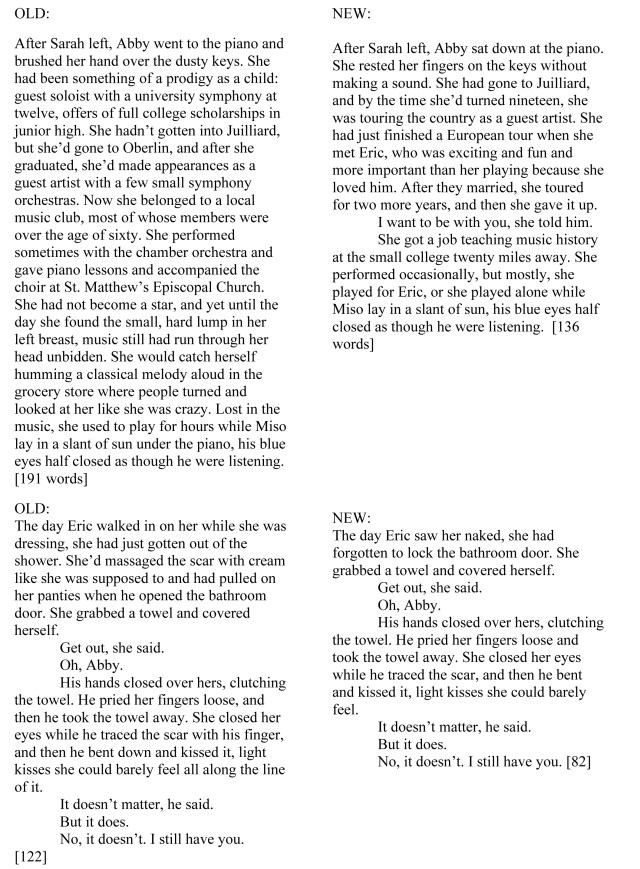
I want to share a couple of examples. This story, “Miracle of Doors,” is about a woman recovering from breast cancer. Out of context, these passages won’t mean much, but they illustrate the kind of cutting and refining I’m talking about. (Her cat, Miso, plays an important role in the story.)

Here they are, side by side:

Old_new_best.pdf
Before, after

This gives you an idea of my “tightening” process when I’m down to the last passes through a story. Sometimes it’s not the number of words but the words themselves that matter most. Maybe you’re able to write concisely or revise as you go. I tend to discover as I go; I write long drafts and whittle them down.

A story draft is the easy part. Revision is key to a polished piece of writing you can be proud of. Before you send the story out into the world: Refine. Make every word count!

Do you have favorite revision strategies? Share one with me!

The Five Stages, Or Facing Up to the Re-write

Hi there.

After completing the October Memoir and Backstory Blog Challenge, I’ve been absent from this space for a while. I wrote twenty-five posts during the challenge, many of which were emotionally grueling. (Here’s a sample post, just about in the middle: Age Twelve: The Great Void.) I’m glad I finished, although I wish I’d done what a friend of mine did. She’s stretching her memoir posts (way to go, Lara!) out over a number of weeks. Smart blogger, that one.

Anyway, I’m back, and I hope maybe you missed me a bit.

I’ve been busy re-writing–for what I hope is the final time–a 300 page novel. The bones of the novel are strong, I think, but there is this one subplot, you see, that needed to be fleshed out. And flesh I did, for several hours every day for a week.

“Child Crying And Lying On Grass” by imagerymajestic
Image courtesy of http://www.freedigitalphotos.net

It occurred to me during this process that facing up to a major re-write is a little like Kubler-Ross’s Five Stages of Grief. Let me explain:

First, Denial: There’s nothing wrong with this character. (Substitute subplot, setting, dialogue, structure . . .) It’s certainly not bad. Maybe it’ll squeak by if I’m lucky enough to have someone read it. Like an agent.

Then there’s Anger: How dare my readers suggest that the book needs more work! I poured my heart, my brain, my sweat and tears into it! I have carpal tunnel syndrome. I’ve had to get stronger glasses. I’ve sacrificed two years of my life! It’s done, and nobody can tell me otherwise!

Next? Bargaining: If I move this one scene about the preacher, then the problem with the flashback within the flashback within the flashback will surely go away. That’s fair, right?

Ah, Depression: “I can’t do this. I’ll never pick up a pen again. I’m worthless and stupid. Why did I ever think I could write a book? I can’t even put a decent sentence together. I can’t even spell. I don’t know a cliche from a bon mot.” Destroy the files. Shred the backup CDs. Go to bed with a bottle of wine and a good book. Somebody else’s book, of course.

Finally? Acceptance. I will go on. I’ll never be the same (poor little bruised writer-ego), but the work has to be done.

I would add a stage of my own, one I experienced over the last few weeks, and that’s Determination: I will tackle the problem, and over time, I’ll solve it. I’ll have a eureka in the middle of the night. I’ll dream the answer. I’ll write it over and over again until I get it right. Whatever it takes, I’ll get it done because it’s necessary. It’s what a writer does.

From helplessness to empowerment: yes, that’s the ticket!

Obviously, dealing with a re-write is nothing like dealing with real grief. We all know that. But in the moment, when all seems lost and the book (or story or poem or memoir) seems impossible to save, haven’t we all felt these emotions? Those who grieve eventually get on with life, and we’ll get on with the book. Won’t we!

How do you cope when you get discouraged with your writing? What or whom do you rely on to find the energy and the will to press on?