Age Seven: An Awakening

Along about this time, an incident took place that nagged at me for years. It has become a short story, but I won’t print it here. I think the memory suffices.

I may have been younger than seven; I can’t swear to how old I was. I was old enough for what happened to make an impression but not old enough to understand the implications.

From my earliest memories, we always had a maid. Some people had cooks, too, or a woman who could both cook and clean. Our maid was mainly a housekeeper. She came every day, I think, although I can’t imagine why. The incident I’m remembering happened in the summer. The maid–I’ll call her Rose–came to work with her two or maybe three children, all close to my age, in tow. When Rose showed up at the back door, my mother was miffed. Rose explained that she didn’t have anybody to keep the children, and rather than miss work, she had brought them with her. I can hear her voice in my head: “They won’t be no trouble, Miss Carra. They play outside, they be fine.”

Mother had some project underway–making jelly, maybe–so she needed Rose to stay. She told the children to go play in the yard, and Rose came inside and went to work. The trouble was, I wanted to play with them. I nagged at my mother until she gave in, but she lectured me to “keep my distance” and to come in when she called. I wondered aloud why those kids couldn’t come inside to play. I got no answer.

So I went out to play with the black children, and we wound up under the walnut tree where the swing was. I don’t remember if any of us played on the swing. I had a package of balloons in my pocket, precious treasure from a trip to the dime store a day or two before. I brought them out, and we children sat in the dirt and began to blow up balloons. The fun got out of hand when I showed them how to blow them up and let them go so they went buzzing and flying all around us. Hysterical with laughter, we began to swap balloons, blow them up, let them go.

Balloons
Image by jdurham/www.morguefile.com

And then my mother showed up. Red-faced with fury, she demanded to know what we were doing, but I didn’t have to tell her. She had been watching us. She yanked me up by the arm and dragged me into the house. All my balloons were left behind.

I don’t recall what happened after that. I suppose the black children stayed on and played in the yard. In my fictional version, their mother takes her dignity and her children and walks away from that job. I’d like to think that was true, but I doubt it. Whatever happened, I was left with the feeling that something wasn’t right.

In fairness to my mother, she had reason to be concerned about me and “germs.” I was sick a lot in those days. She would not have considered herself a racist. It was all she knew. It was what I learned, too: a cultural context of racism that I wouldn’t unlearn for many years. That day, though, for a little while, we children saw only those brightly colored balloons. The color of our skin didn’t matter.

I wonder how those children felt, having their playmate taken away from them, or if the left-behind balloons were enough. I wonder if they sensed the discrimination at the heart of it and if the story stayed with them the way it has stayed with me.
The Tender, Magical Age of Six . . .

When Santa can deliver a piano down the chimney. When it takes three little boys to walk you to your mother’s car after school: one to carry your books, one your art portfolio, and one . . . well, the cutest was just window dressing.

First grader

In our little town, there was no kindergarten, but I was reading and writing by the time I entered first grade. I was also talking. A lot. Miss Agnes Ray, who had taught my mother when she was in the first grade, got enough of me one day and spanked my hand with a ruler. In fairness I have to say she had warned me more than once. I still remember how my palm stung, but I remember even more how humiliated I felt. It wasn’t over then, either. My best friend told her mother, and her mother told mine, and the hole of trouble got deeper. I didn’t talk so much in class after that.

About that piano

I remember we went to Memphis to shop for pianos so Santa would know which one to bring. In the music store, I spotted a piano with a big red SOLD sign on it and our last name. You should have heard my parents talk their way out of that one, but it was similar to the way they explained the street-corner Santas. They were all Santa’s helpers, my dad said. Santa couldn’t be everywhere at once. That piano must have been delivered to Daddy’s store and hidden in the back part that was like a warehouse. How he (and whoever helped him) got it into the house on Christmas Eve without waking me up remains one of the great mysteries of my childhood. Bordering on miracle, that’s what it was. But then, you’d have to know my dad.

Plate-glass windows

Daddy hadn’t been in the parts business very long when I was six. I loved his store. It had two big plate-glass windows, a serious office-looking desk near the front, and against the wall, a bookkeeping desk where all the account files were kept, a file cabinet with a radio on top, and on the wall, a NAPA calendar featuring forties-type beauties (a little racy; I’m surprised my mother let him get away with that one), cold concrete floors, a big heater, a long counter for serving customers, and behind that counter rows of tall bins that held the automobile parts, hundreds of them. The store often smelled of motor oil or paint, but that didn’t bother me. I loved to play among the bins and pretend they were caves or secret passageways. There was something a little shivery about those dark tunnels, but I could always come out into the light, and Daddy (and often Mother, too) would be there.

Busy dad (note the receding hairline)

About the time I started school, my mother began “keeping the books” for the business. I spent many hours playing at that big desk by the window that looked out on the street. You wouldn’t think much happens in a little north Mississippi town with fewer than 2000 people, but you might be surprised. A lot of life moved past that window.

Going back

I went in that building a couple of years ago. It’s now an antique shop, the brick facade painted dark red. I didn’t want to go in, but my husband encouraged me to do it. “You never know what you might remember,” he said, and he was right. The place felt incredibly small. The bins were gone, of course, and the automobile smells, but the pressed tin ceiling was the same, and I would almost swear I smelled Daddy’s pipe tobacco and heard the ching of the cash register.

Here’s a bit of a poem, “Parts,” about that place and time:

The storefront faced west, the plate-glass window gilded

by the late sun’s angle, hiding what was inside:

The concrete floor stained black with motor oil that poured

like syrup in winter. Smells of paint, metal, rubber, tobacco.

The slide and ding of the cash register.

The tall bins rose, ominous and unsteady, toward the ceiling,

the aisles between them tunnels, their shelves heavy with parts:

spark plugs, carburetors, batteries, fan belts. I knew them all.

In this memory, the windows are spattered

with canned snow, Merry Christmas painted on backwards.

We are there together, my father, my mother, and I.

Through the plastic mist we watch the Christmas parade pass,

the band’s music thin and distant as the shabby Santa who lifts

his slow-motion mittened hand in our direction.

What places are most significant in your early memories? Have you had the opportunity to go back?

This post is part of the October Memoir and Backstory Blog Challenge launched by Jane Ann McLachlan. For previous posts, see Recent Posts in the right column.

Age Two: Memory or Story?

This is the second entry in the October Memoir and Backstory Blog Challenge.

As I cast about for early memories, I have trouble distinguishing among what I remember, what I was told, and what I’ve seen in photographs. So I may be creating fictions here, and all along the way, actually.

I do have vague early memories of the house we lived in. My parents had moved in with my maternal grandparents before I was born, and we stayed–three generations under one roof, my maternal grandfather sick and dying in the back bedroom that opened right off mine. (That’s a story for later.) A red brick house with the side porch and tall junipers at the front corners. The cramped kitchen, the dining room table with a quilt thrown over it so I could play house, the one bathroom we waited in line for. The unfinished basement, carved out of red clay and braced with wood, jars of my grandmother’s jellies and pickles lined along earthen shelves. Dark, damp, scary. The big green yard and the vegetable garden out back. A ramshackle garage with a storage room on the side and stall-like spaces behind it. A barn, once upon a time?

Chickens. I seem unconcerned.

Chickens in the yard.

The rope swing Daddy hung on the walnut tree north of the house. Push me, push me! Walnuts on the ground, their hard outer husks turned black. Cool and dark in that shade, no grass growing. The white dog named Pokey who wouldn’t let me out of her sight. Our maid, Nita, a large, soft woman who would put me in the stroller and meet her friend who was nursemaid to a little boy about my age, and they would stroll us all the way to town and back. How I wish I could remember what they talked about.

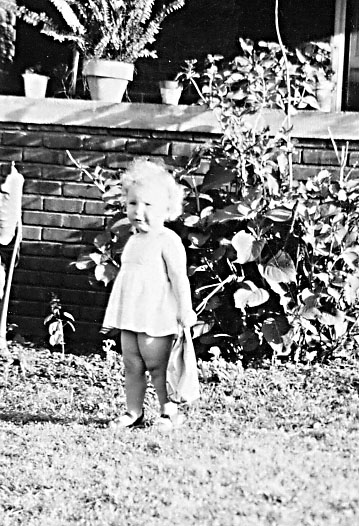
For love of bananas.

Here I am. Unruly, curly hair. Chubby legs. What’s that in my hand? I believe it’s a brown paper sack of bananas. My Uncle Jim, nearly 20 years older than my dad, had brought me bananas! Why? Were bananas hard to come by in rural north Mississippi in those days? Maybe so. But I loved bananas, even though sometimes if I ate too much, they gave me a tummy ache. I loved my uncles, that one especially. He was a substitute for the paternal grandfather I don’t remember, the one who died just days before Christmas, three months after I turned two. Uncle Jim was a big man who smelled of cigarettes. He cursed–a lot–but he had the biggest heart in the world. A few years after this photo was taken, he plucked me from the path of a car.

Around the age of two, my parents took me to the zoo in Memphis for the first time. This was a major outing—at least a two-hour car trip—and I remember getting carsick in the back seat because of my dad’s cigar smoking. Soon after, he switched to a pipe. I still love the smell of pipe tobacco and will always associate it with him.

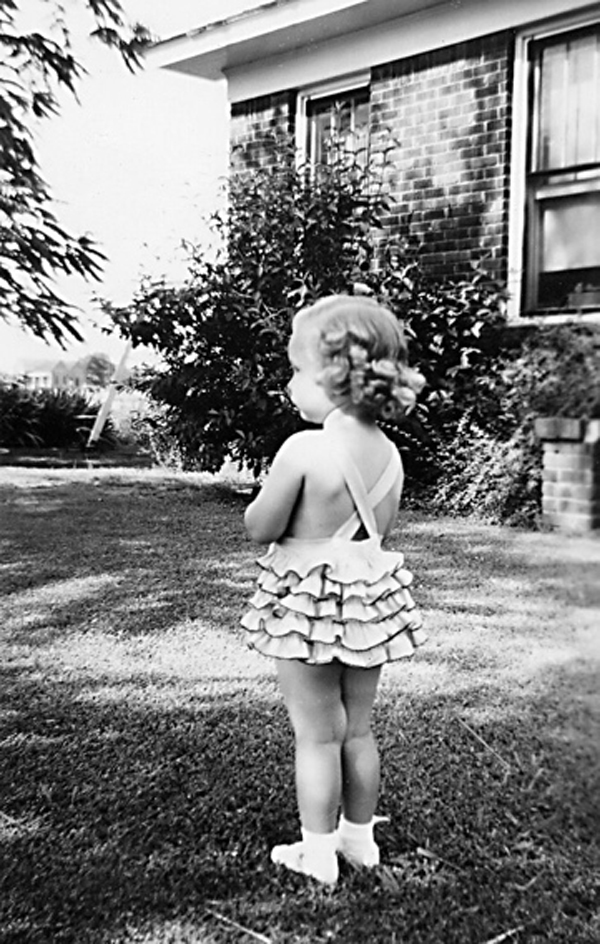
I remember what I wore that day–a yellow sunsuit with brown stitching trim and ruffles on the seat. I remember no animals I saw that day except the giraffe that sneezed on me. That made an impression! I remember eating popcorn for the first time. We ate in a restaurant on the way home. All important firsts.

Here’s that sunsuit. I may be cheating. I may have been closer to three years old here than two.

Ruffles. I loved this sunsuit.

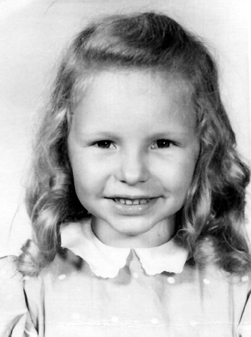
And here I am, still, after so many, many years.

The story goes that my dad once told someone who dared to ask him why he and Mother never had more children, “She’s all in the world we ever wanted.” I knew, even at the age of two, that I was the center of the household. Their world revolved around me. Spoiled? Yes, I’d say so. But my daddy owned a service station then. He had a high school education. My mother had wanted to go to nursing school, but her parents disapproved and so she didn’t go. College was out of the question for her. Her mother had not gone past the eighth grade. I didn’t realize until I was forty the pressures their expectations placed on me. I wasn’t perfect. I never would be, and yet I represented what my parents and grandparents had never had themselves. They hung their dreams on me.

It’s all quite complicated, isn’t it, no matter how idyllic the childhood?