The Five Stages, Or Facing Up to the Re-write

Hi there.

After completing the October Memoir and Backstory Blog Challenge, I’ve been absent from this space for a while. I wrote twenty-five posts during the challenge, many of which were emotionally grueling. (Here’s a sample post, just about in the middle: Age Twelve: The Great Void.) I’m glad I finished, although I wish I’d done what a friend of mine did. She’s stretching her memoir posts (way to go, Lara!) out over a number of weeks. Smart blogger, that one.

Anyway, I’m back, and I hope maybe you missed me a bit.

I’ve been busy re-writing–for what I hope is the final time–a 300 page novel. The bones of the novel are strong, I think, but there is this one subplot, you see, that needed to be fleshed out. And flesh I did, for several hours every day for a week.

“Child Crying And Lying On Grass” by imagerymajestic
Image courtesy of http://www.freedigitalphotos.net

It occurred to me during this process that facing up to a major re-write is a little like Kubler-Ross’s Five Stages of Grief. Let me explain:

First, Denial: There’s nothing wrong with this character. (Substitute subplot, setting, dialogue, structure . . .) It’s certainly not bad. Maybe it’ll squeak by if I’m lucky enough to have someone read it. Like an agent.

Then there’s Anger: How dare my readers suggest that the book needs more work! I poured my heart, my brain, my sweat and tears into it! I have carpal tunnel syndrome. I’ve had to get stronger glasses. I’ve sacrificed two years of my life! It’s done, and nobody can tell me otherwise!

Next? Bargaining: If I move this one scene about the preacher, then the problem with the flashback within the flashback within the flashback will surely go away. That’s fair, right?

Ah, Depression: “I can’t do this. I’ll never pick up a pen again. I’m worthless and stupid. Why did I ever think I could write a book? I can’t even put a decent sentence together. I can’t even spell. I don’t know a cliche from a bon mot.” Destroy the files. Shred the backup CDs. Go to bed with a bottle of wine and a good book. Somebody else’s book, of course.

Finally? Acceptance. I will go on. I’ll never be the same (poor little bruised writer-ego), but the work has to be done.

I would add a stage of my own, one I experienced over the last few weeks, and that’s Determination: I will tackle the problem, and over time, I’ll solve it. I’ll have a eureka in the middle of the night. I’ll dream the answer. I’ll write it over and over again until I get it right. Whatever it takes, I’ll get it done because it’s necessary. It’s what a writer does.

From helplessness to empowerment: yes, that’s the ticket!

Obviously, dealing with a re-write is nothing like dealing with real grief. We all know that. But in the moment, when all seems lost and the book (or story or poem or memoir) seems impossible to save, haven’t we all felt these emotions? Those who grieve eventually get on with life, and we’ll get on with the book. Won’t we!

How do you cope when you get discouraged with your writing? What or whom do you rely on to find the energy and the will to press on?
The Letter that Crisscrossed the World

Now and then, I go through boxes of family letters and photos out of guilt, if nothing else, because I’ve never organized them properly. So much history will disappear if I don’t do something, but the task is daunting.

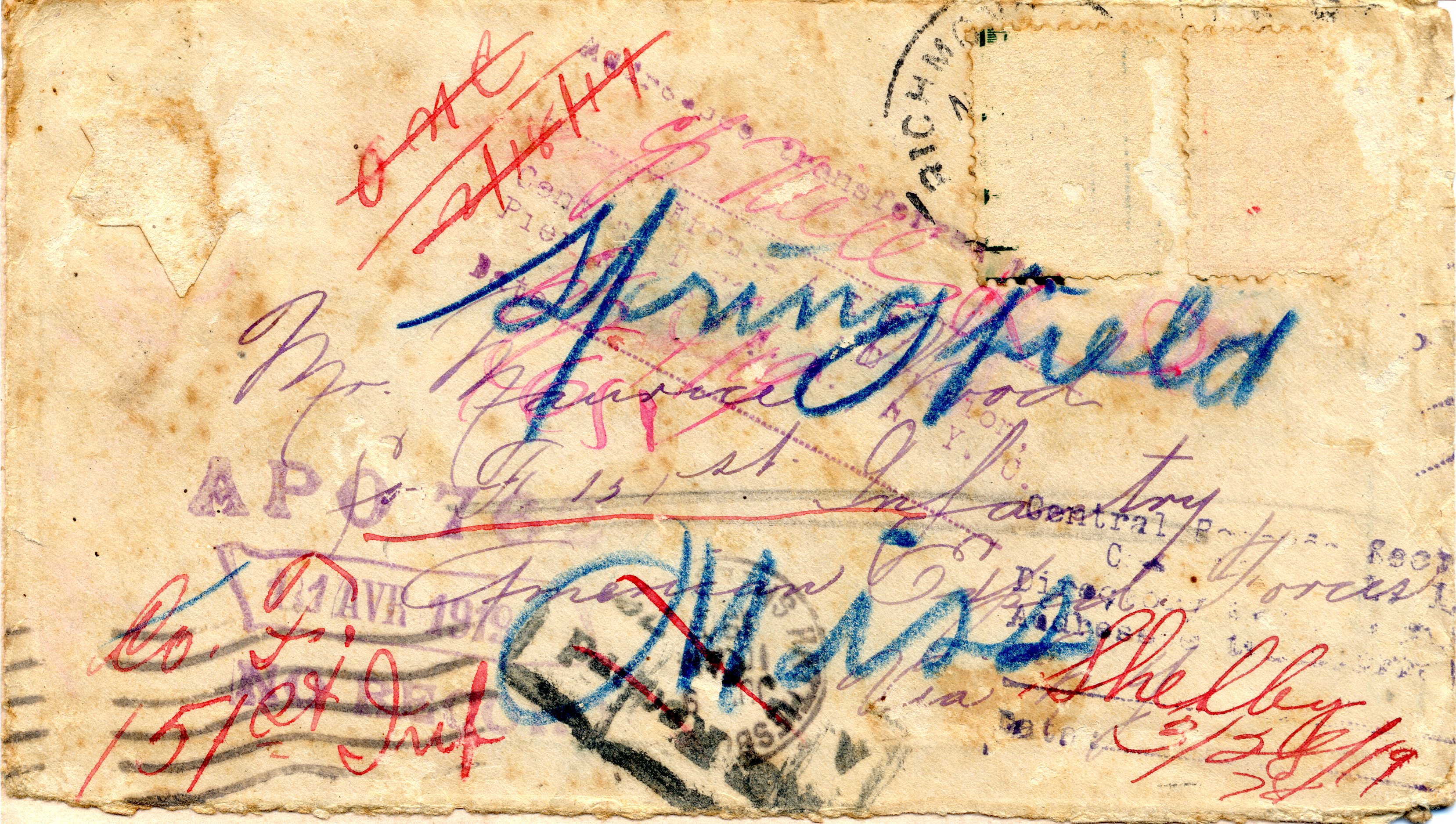
Papaw’s Letter, front

The Letter

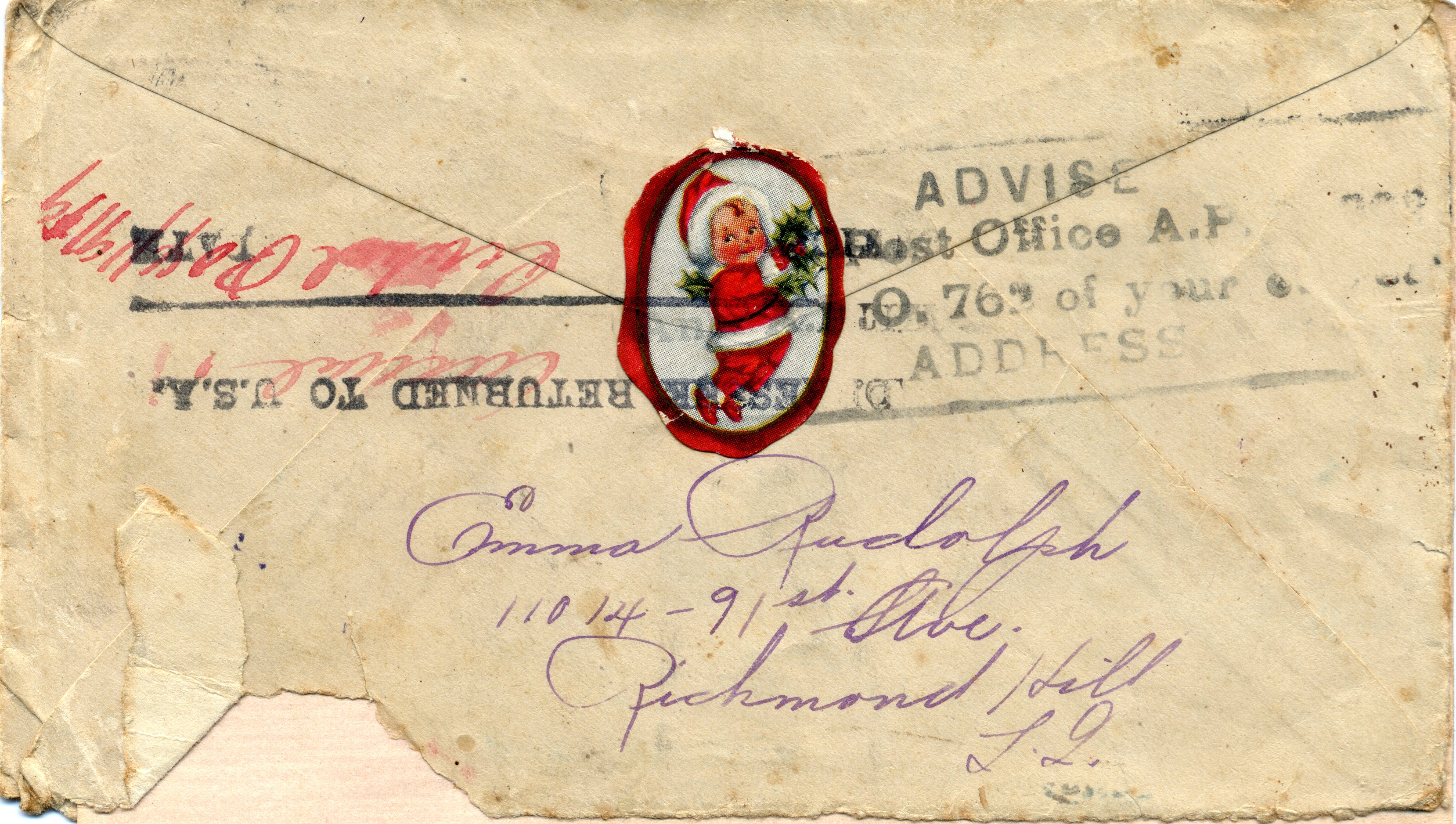
The envelope above, crisscrossed with post office cancellations, forwards, dates, and addresses, caught my eye the other day. It tells the story of a letter that followed my grandfather to France and back during the last months of World War I and after. It was not written by my grandmother.

My grandmother always told me that she and my grandfather met at an ice cream social on a Sunday afternoon. She was “engaged” to another young man at the time, but my grandfather came along that day in his doughboy uniform, and when she saw him across the room, she knew. He shipped out for France soon after. I have only empty envelopes addressed to him in my grandmother’s hand; I don’t know what happened to those letters. I do know that his ship, the Agamemnon, arrived back in New York Harbor on March 11, 1919, and they were married May 24, 1919. A two-month courtship!

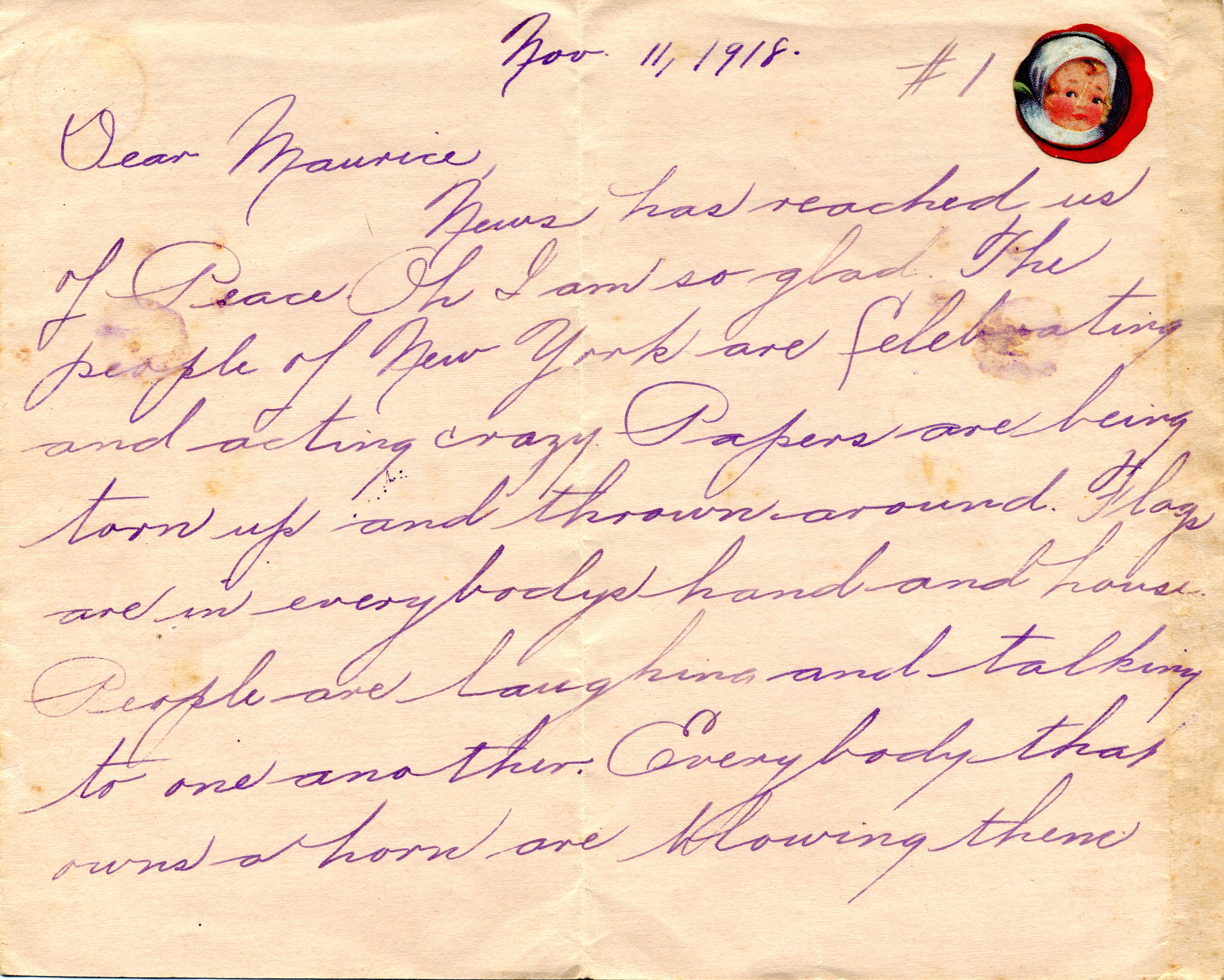
Emma’s Letter, page 1

One Story, Many Versions

Back to the letter: the writer’s name was Emma Rudolph of Long Island, New York.  Apparently, it was customary for New York families to befriend soldiers caught in the limbo of shipping out or returning home. What must that have been like–a twenty-seven year old man from rural Mississippi in the big city for a few days before he went off to war! He was handsome, blue eyes, blond hair, tall. And from the tone of the letter, I believe Emma was smitten.

I had always believed my grandfather stayed with her family after he returned, but that turns out not to be true. He had met Emma Rudolph before he left for France. In her letter dated November 11, 1918–Armistice Day!–she wrote about celebration in the streets of NYC. “New York is alive,” she wrote. “Our place is closed up for the day. Hurrah for peace . . .” And then she penned these words:

“Write to me, won’t you?”

Her letter went to his APO address and on to Camp Shelby in Mississippi, where he had trained, arriving there March 22, 1919–the same month he arrived back in the States—then on to France, postmarked there [date unclear] Avril 1919. It came back to the States and was forwarded, finally, to “Springfield,” Mississippi. My grandfather’s little community was Springville, not Springfield. The date of its arrival in Springville is illegible. (You’re welcome to turn your computer upside down and try to read it!) Were he and my grandmother married by the time he got that letter? Did he ever write to Emma? Did she ever know he was safe, or that her little letter had followed him across the Atlantic and back? (The photos here are a bit larger than its actual size.)

Papaw’s Letter, back

What If?

So many what if’s–the makings of a good story. What if he had fallen in love with Emma of Long Island, New York? What if the letter had reached him and he had stopped off to see her on his way home? What happened to her? She says in her letter that she hasn’t heard anything from him since he went away, but the letter has a pleading tone: “If when you come back you are in a camp near enough to come and see me, you are welcome.”

Strange turns of fate, that bring us, and our stories, into being!

Letters–never sent or gone astray–play an important role in my WIP, Spirit Lamp, a work of historical fiction set during World War I. Thank you, Emma Rudolph, whoever you were. And thanks to my maternal grandparents, too. If you hadn’t gotten together . . .

Have family artifacts or stories informed your writing? If so, how? Tell me about it!

Wordle 65: A Little Fiction

Here are this week’s words at The Sunday Whirl. Wordle 65 made for quite a challenge, especially one of the words. I bet you can guess which one:

flicks, swells, spray, grittle, gravity, plant, trigger, relishes, chain, crack, humility, refrain, claim

Here’s the result of my playing with these words–a bit of fiction:

Seven Letters, Starts with G

“What’s a seven-letter word, starts with gr, has an l second letter from the end?”

Lori ticked off letters on her fingers. “Grabble? Grapple?”

Harry tried them. “Nah. I don’t think so. Doesn’t work with 13 down. That’s r-a-p-t. Rapt.”

Lori scribbled a few words. “How about griddle?”

Harry chewed the end of his pen. She hated it when he did that.

“If rapt is right, then there’s a t where one of the d’s would be. Gritdle? Gratble?” He shook his head. “You’re no help.”

She flicked the dish towel at him.

“Ow,” he said. “Refrain from the abuse, would you please?” He grinned, and she aimed a pretend gun at him and pulled the trigger.

Pow. See? Rhymes with ow.”

“Ha,” Harry said.

She was finishing up in the kitchen, but he hadn’t yet left the table. He was like a crack addict when it came to his crossword puzzles. First thing every morning while he ate his breakfast. The easy puzzle first, then the syndicated New York Times puzzle edited by Will Shortz. All while she showered and dressed and slugged down coffee and grabbed a Pop Tart before she left the house at seven to go process claims at FiveStates Insurance Company in downtown Ithaca. She hated that job. A computer programmer, Harry worked from home these days. She wasn’t sure what he did exactly. Maybe he worked puzzles during the day, too, but then after dinner, he was back at it.

She wasn’t going to be stuck at FSIC forever. She was writing at night, or before Harry got up, sometimes as early as four in the morning. It was her true work, her calling, the dark, romantic fantasy with a heroine who sprayed diamonds from her fingertips like bullets and whose breasts, Lori had just written a couple of days ago, were like “the swells of waves in a high sea.” She relished those words. She relished that time when she didn’t feel chained to a desk. Chained to Harry.

She shook her head. Had she just thought that? Yes, she had.

She was almost done in the kitchen now. She nested the clean casserole dish inside another, but it slipped and bounced out of her hands and shattered on the tile floor.

Harry dropped his pen. “Good God, Lori! Can’t you be careful?”

“It’s called gravity, Harry. It slipped. It fell.” Her heart pounded. She was close to tears. He’d gone back to his puzzle. Damn you, she thought. She picked up the biggest pieces and dropped them in the trashcan. Then she got the broom and dustpan out of the closet and started sweeping up the glass. She got a sliver under her fingernail.

“Ouch! Oooh!” She was crying now.

“Hey,” Harry said. He got up from the table. “Let me help.”

“I’m done. I don’t need your help. I don’t need you. Why don’t you take your damn puzzles and leave?”

“Leave?” Harry looked stunned. “Uh uh. I don’t think so. You think you could make it without me? I saw that, that novel, or whatever it is you’re writing. I read it. It’s awful.” He took the dustpan from her and dumped it. The broken glass made a kind of pleasant sound going in the trash, a little like a wind chime. I could use that in the book, she thought. A nice detail.

“It’s good, Harry. I know it’s good. I think I can sell it.”

He put the dustpan away. She was still standing there with the broom and her bloody finger. He handed her a tissue. “I’ll say one thing. Humility’s not your strong suit, is it?”

She slammed the broom into the rack inside the pantry. She grabbed her coat off a chair and her keys off the table.

“Where you going?”

Lori planted her feet, squared her shoulders. “Out.” She opened the door, but then she stopped and turned to look at him. “It’s grittle,” she said.

“It’s what?”

“Grittle. The word you couldn’t get.”

He laughed. “Never heard of it. You’re making that up.”

“No I’m not. It means something like a coarse grind, or what you get after a coarse grinding. What’s left. The nitty-gritty, Harry. Go look it up.”

And she was out the door.