“Intense, riveting, deftly crafted, author Gerry Wilson has created an original story that is raised to an impressive level of literary excellence.” — Midwest Book Review, Historical Fiction Shelf, July 2024
LITSTACK: “Water and Blood: Family Ties Strengthen That Pinson Girl” by Allie Coker
“Wilson expertly presents a devastating landscape that left me crying, hoping, and holding my breath for answers as she unravels each mystery at an organic pace. I highly recommend That Pinson Girl for its deep exploration of different versions of loss—death, grief, dysfunction, sense of purpose— as well as its precise prose.”
CHAPTER 16: “Deception, War, Murder?” by Abbie N. Lewis, February 7, 2024
“Though the overall story is tense and suspenseful, Wilson doesn’t adhere to the action-focused narrative of many crime and mystery novels. Rather, her seventh-generation Mississippian roots bring a storytelling style that pays attention to nature, unspoken social cues and expectations, and the silent dignity of living in poverty in the South.”
MISSISSIPPI BOOK PAGE: “Realistic historical fiction novel follows a Mississippi single mother living a hardscrabble life” Review by Alex Brower, February 12, 2024
“Leona is a relatable, if sometimes infuriating, main character. At times I wanted to shake her and get her to just speak up! Tell people what you are feeling and who did this to you! But really, she can’t. Women were not empowered, and any event would have been turned around to be her fault.”
“[Gerry Wilson] writes about a complicated time and place where racism, sexism, and poverty abound. But even amid such dreadfulness, Wilson shows the reader love, hope, and reconciliation.” — Regina Allen
“But to the novel’s great credit, Leona never comes across as a victim; instead, Wilson makes clear her determination to survive, and to give her son the best life possible. I was moved by her resolve and by Wilson’s vivid and deeply felt writing about her.”
“Many writing careers begin in an English class, but in Gerry Wilson’s case, the classroom was her own.” —Emily Liner interviews Gerry Wilson for the Columbus Dispatch, Columbus, MS.
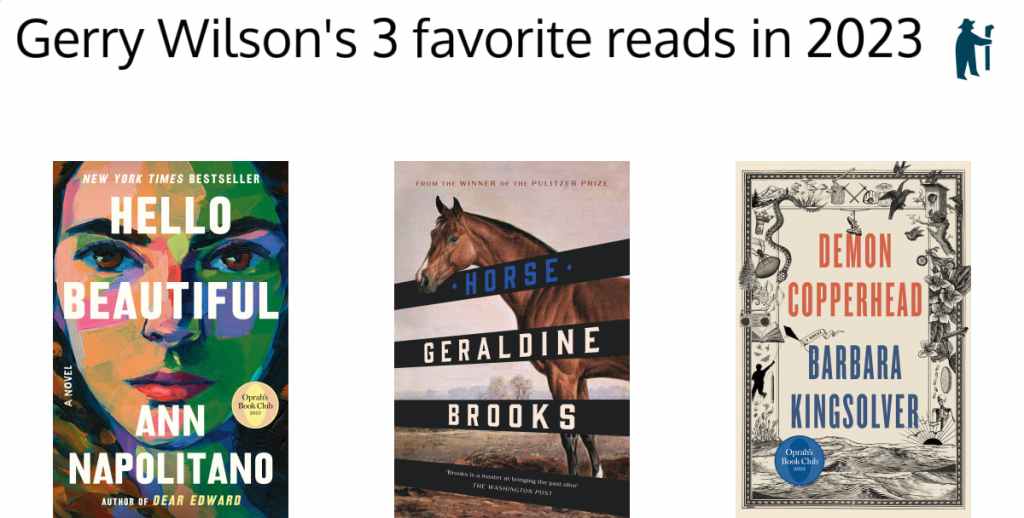
GERRY’S “3 FAVORITE READS OF 2023” at SHEPHERD01.29.24:
It was great fun to share my three favorite novels of 2023 with Shepherd. Do take a look, and while you’re there, check out their extensive booklists where you can find just about ANY topic and theme you’re looking for. They’re great about featuring authors, too! I had a hard time narrowing my favorites to three. I’m wondering if any of mine are also yours?
Q: Did you know how the novel would end before you started writing it, or did you make many changes along the way?
A: I had a sense of how I wanted it to end all along. What changed dramatically over the course of many rewrites was how to get there. I already mentioned that the characters underwent drastic changes, which ultimately reshaped the ending.
What a great conversation with Kara. Her premise is to ask authors to come up with a “flight” of three authors they love and recommend. My flight? Three generations of Mississippi women authors: Eudora Welty, Jesmyn Ward, and Katy Simpson Smith.
Robin’s conversations focus on books that have influenced her guests’ writing, books that we can all learn from. I chose three books by Mississippi women authors: 1) Eudora Welty’s A Curtain of Green, focusing especially on “A Worn Path,” one of my all-time favorite short stories; 2) Jesmyn Ward’s Sing, Unburied, Sing (bringing us into the 21st century); and 3) Katy Simpson Smith’s The Story of Land and Sea, the novel that nudged me toward writing historical fiction. These books (and Robin!) made for a great conversation.
Dave is such a gracious host! Living the Next Chapter was my first-ever podcast, and he made me feel quite at home. Our conversation drifted toward sharing a little writing “advice,” which I enjoyed doing. He brought out the teacher in me! So thanks, Dave, for a good conversation.
 Gerry Wilson