Age Three: Some Life Lessons

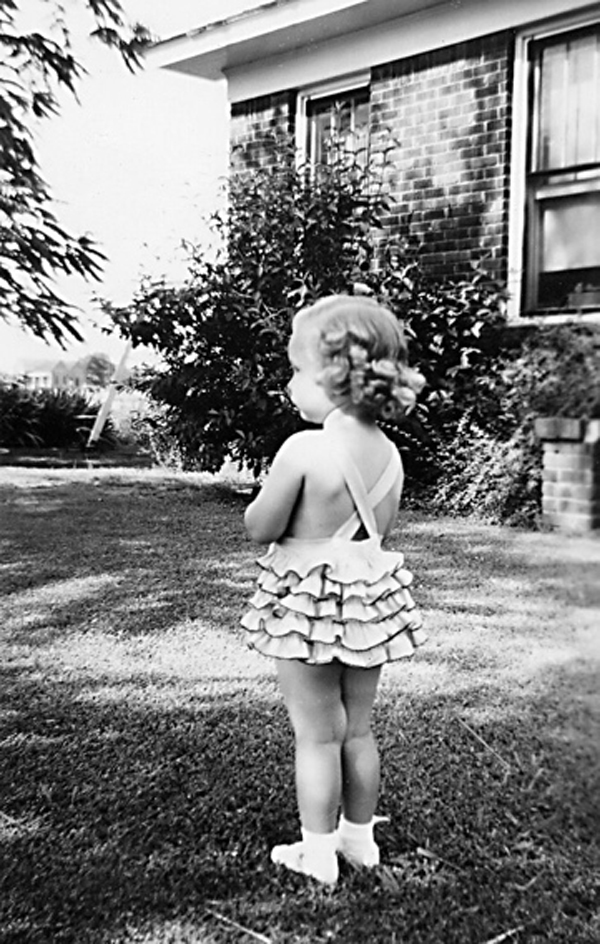
A dress my mother made for me

When I was three years old, my paternal grandmother died just days before Christmas, almost a year to the day after her husband had died. What awful Christmases those must have been for my dad, but I never knew it. As I said earlier, I have no memory of my dad’s father. I don’t remember his mother, either, but I remember the wake. I remember being carried into that little house that felt close and hot (it was late December, after all) and seeing a big box placed against the back wall of the living room. The room was dimly lit, but there was no avoiding that box. My grandmother was inside it. I remember wondering why she was sleeping there. I didn’t associate her stillness with “dead.” I had never seen anything lifeless. I didn’t know what dead was.

I filed that image away in memory. Many years later, thinking maybe I had dreamed it, I finally asked my mother if she and Daddy had really taken me to the house after my grandmother died.

She looked at me sort of funny. “We did,” she said. “Why?”

“Well, I remember it.”

She shook her head. “That’s not possible. You were too little.”

“But I do.” I described the room and where the casket was placed against the wall and how it seemed like I was looking down at my grandmother.

“It’s because your daddy was holding you,” Mother said, looking stunned. “That would explain why you were looking down.” I don’t remember whether Mother asked me if I was afraid. I was later, with other deaths, but I did not see another dead person until I was ten years old.

“There was a little girl who had a little curl
Right in the middle of her forehead . . .”

An only child, by the time I was three, I was used to playing quietly by myself. I was a girly-baby doll kind of little girl. I had already begun to collect storybook dolls. Each time my dad went to Memphis on business, he brought me a “surprise”–sometimes a little doll (Bo Peep, Cinderella, Little Red Riding Hood . . .), sometimes something very special, like the rabbit fur hat and muff that made me sneeze. I loved pretty dresses. My mother was pretty, and I wanted to be pretty, too. (She did her part, rolling my hair in pin curls to try and tame it.)

I loved playing dress-up. I could make a playhouse out of anything–under the table, outside under the willow tree or even under a shrub!

Early morning dress-up time

About this time, the first thing I did every morning was put on a pair of my mother’s slingback heels and a hat and stash a big purse under my arm and head out to the garden. Never mind that I was still in my nightgown or that my hair was in pincurls. Nothing stopped me!

Meanwhile, in the house, there was sickness. But that’s a story for another day.

Maybe I was already learning to escape.

I still have some of those dolls, by the way. What childhood mementos do you have? What brings the memories back?

Age Two: Memory or Story?

This is the second entry in the October Memoir and Backstory Blog Challenge.

As I cast about for early memories, I have trouble distinguishing among what I remember, what I was told, and what I’ve seen in photographs. So I may be creating fictions here, and all along the way, actually.

I do have vague early memories of the house we lived in. My parents had moved in with my maternal grandparents before I was born, and we stayed–three generations under one roof, my maternal grandfather sick and dying in the back bedroom that opened right off mine. (That’s a story for later.) A red brick house with the side porch and tall junipers at the front corners. The cramped kitchen, the dining room table with a quilt thrown over it so I could play house, the one bathroom we waited in line for. The unfinished basement, carved out of red clay and braced with wood, jars of my grandmother’s jellies and pickles lined along earthen shelves. Dark, damp, scary. The big green yard and the vegetable garden out back. A ramshackle garage with a storage room on the side and stall-like spaces behind it. A barn, once upon a time?

Chickens. I seem unconcerned.

Chickens in the yard.

The rope swing Daddy hung on the walnut tree north of the house. Push me, push me! Walnuts on the ground, their hard outer husks turned black. Cool and dark in that shade, no grass growing. The white dog named Pokey who wouldn’t let me out of her sight. Our maid, Nita, a large, soft woman who would put me in the stroller and meet her friend who was nursemaid to a little boy about my age, and they would stroll us all the way to town and back. How I wish I could remember what they talked about.

For love of bananas.

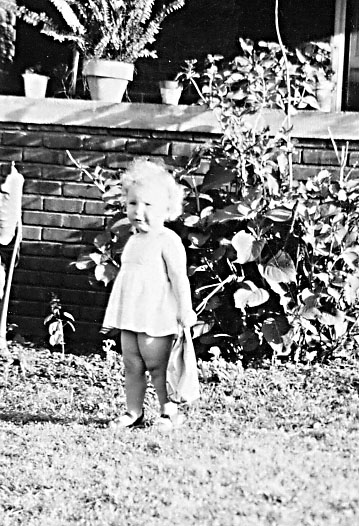
Here I am. Unruly, curly hair. Chubby legs. What’s that in my hand? I believe it’s a brown paper sack of bananas. My Uncle Jim, nearly 20 years older than my dad, had brought me bananas! Why? Were bananas hard to come by in rural north Mississippi in those days? Maybe so. But I loved bananas, even though sometimes if I ate too much, they gave me a tummy ache. I loved my uncles, that one especially. He was a substitute for the paternal grandfather I don’t remember, the one who died just days before Christmas, three months after I turned two. Uncle Jim was a big man who smelled of cigarettes. He cursed–a lot–but he had the biggest heart in the world. A few years after this photo was taken, he plucked me from the path of a car.

Around the age of two, my parents took me to the zoo in Memphis for the first time. This was a major outing—at least a two-hour car trip—and I remember getting carsick in the back seat because of my dad’s cigar smoking. Soon after, he switched to a pipe. I still love the smell of pipe tobacco and will always associate it with him.

I remember what I wore that day–a yellow sunsuit with brown stitching trim and ruffles on the seat. I remember no animals I saw that day except the giraffe that sneezed on me. That made an impression! I remember eating popcorn for the first time. We ate in a restaurant on the way home. All important firsts.

Here’s that sunsuit. I may be cheating. I may have been closer to three years old here than two.

Ruffles. I loved this sunsuit.

And here I am, still, after so many, many years.

The story goes that my dad once told someone who dared to ask him why he and Mother never had more children, “She’s all in the world we ever wanted.” I knew, even at the age of two, that I was the center of the household. Their world revolved around me. Spoiled? Yes, I’d say so. But my daddy owned a service station then. He had a high school education. My mother had wanted to go to nursing school, but her parents disapproved and so she didn’t go. College was out of the question for her. Her mother had not gone past the eighth grade. I didn’t realize until I was forty the pressures their expectations placed on me. I wasn’t perfect. I never would be, and yet I represented what my parents and grandparents had never had themselves. They hung their dreams on me.

It’s all quite complicated, isn’t it, no matter how idyllic the childhood?

Monday Discovery: Joe Bunting’s The Write Practice

At The Write Practice, Joe Bunting offers not only sound writing advice; he offers the opportunity to practice whatever skill he’s exploring on a given day. This article, 16 Observations About Real Dialogue, is one of the best I’ve read. Very practical.

For example, here’s Observation # 5:

5. Real People Refuse to Repeat Themselves

Sometimes, when the other per­son can’t hear and says, “Huh? What did you say?” real peo­ple don’t repeat them­selves. They say, “Nothing. It’s not impor­tant. Never mind. I’ll tell you later. Forget it.”

Sometimes, this leads to bickering.

This tech­nique is espe­cially effec­tive if a char­ac­ter has just said some­thing vul­ner­a­ble. People will rarely repeat some­thing embar­rass­ing or hurt­ful or vul­gar. You can draw atten­tion to their vul­ner­a­bil­ity by hav­ing them refuse to repeat themselves.

“Team Solitary”
Image Courtesy of Idea go/FreeDigitalPhotos.net

Visit  The Write Practice, a great resource  for both beginning and more experienced writers.