Read It and Weep (Not)

I’ve been thinking about critiques—how to give and receive them. An online group I belong to, an offshoot of the My Name Is Not Bob Platform Challenge (April 2012), has bonded as an active, online community, and now we’re looking for ways we might support each other. One way is through “reading and responding” to each other’s work. I actually prefer that term to critique; critique sounds so clinical.

So how do we offer honest, valuable feedback? How do we go about responding to someone else’s writing without falsely patting the writer on the back and praising the work—without offering anything substantial that might help the writer improve the piece—or going to the opposite extreme with a “slash and burn” technique that leaves the writer in ruins and makes her want to rip the story up—literally—and never write again? I exaggerate, but you get my point.

If You Can’t Stand the Heat

I actually witnessed the latter once at a prestigious writers’ conference where someone I knew was so crushed by the critique of her poems by a craggy, handsome older poet, every bit as prestigious as the conference itself, that she packed up and went home. Overly sensitive, you might say. If she couldn’t take the heat she should have stayed out of the kitchen. Maybe so, but any criticism that is not delivered in a positive context, with integrity and compassion, is not worth its salt.

I know many of you are already practiced readers. You could teach me a thing or two, and I actually hope you will by leaving comments. Let’s get a dialogue going here! For those who might not be as familiar with the process, I’d like to offer some suggestions. None of these ideas are original with me. They’re common practice among many writing groups.
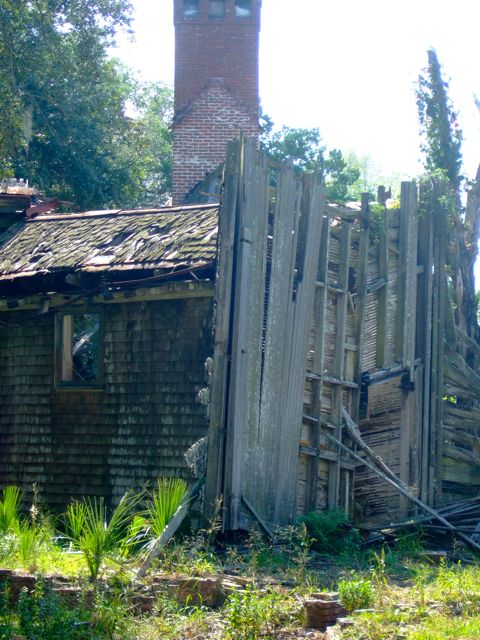
Cottage ruins, Cumberland Island, Georgia

Disaster-proof!

I taught creative writing to high school students for more than twenty years. Talk about potential for disaster—a room full of teenagers let loose to “critique” each other’s writing! We had to have guidelines, and I believe they apply as well to adults in a similar situation. So here goes:

  • Read the piece once, all the way through, without stopping to ponder too much or make notes. Then read it again, more closely this time, paying attention to what works and what doesn’t. Consider the elements of craft (I’m thinking fiction here)—plot, characterization, language, setting, opening/ending, etc.—particularly anything the writer has expressed concern about.
  • Always, always start by commenting on strengths: identify what the writer has done well. No generalizations allowed: no “I really liked it,” or “I think it’s good,” or “Great job!” Those statements may be true; you may feel them, but they don’t help the writer in concrete ways. Say specifically what you thought worked well and why: “The dialogue sounds real; I could hear those characters speaking.” “I was intrigued by the plot turn when  . . . [something happened].” “Your setting details really establish the mood of the story.”
  • Make your constructive comments specific. Notice I don’t say critical comments, but constructive, which means, hopefully, that the comments will be useful to the writer. Try couching your negatives as questions or “I” statements: “Could you clarify what happens here?” instead of “That’s so confusing.” Or “I didn’t understand the time shift when . . .” instead of “Wow, you really lost me!” or even worse, “This makes absolutely no sense!”

Tough Story-Love

Some of you may consider this a “touchy-feely” approach to critique. I’m not saying you can’t offer tough love for a story. It’s what most of us need. If all we want is vapid praise, we aren’t really serious about this writing business, and we aren’t willing to do the work necessary to succeed. But being a good reader also requires skill, hard work, and thoughtfulness. It’s a gift you offer to another writer.

Remember: as a reader of someone else’s priceless work, be respectful, be honest, be specific, be constructive! 

Tomorrow, I’ll address the other side of the critique desk (or more likely, these days, the computer screen). How should the writer receive feedback? Stay tuned. 

Meanwhile, please leave a comment about your own experiences as a reader of others’ work or as a recipient of “feedback.” Or leave a reader-tip to add to the above! I’d love to hear from you.

Lucky 7 Meme Challenge

E. B. (Erin) Pike at Writerlious has tagged me for the Lucky 7 Meme Challenge. Thanks, Erin!

Now it’s my turn to post from a work-in-progress and tag seven more writers to do the same.

The rules:

  • Go to page 77 of your current WIP manuscript.
  • Go to line 7.
  • Copy down the next 7 lines – sentences or paragraphs – and post them as they’re written. No cheating!
  • Tag 7 authors.
  • Let each and every one of them know.

Here are seven lines from Spirit Lamp, a work of literary historical fiction set during WWI in rural Mississippi. The novel is complete, and I just finished making a tough revision pass through it. Now it’s on to considering my readers’ responses and composing the dreaded query letter!

In these lines the main character is remembering going hunting with her father. They  begin in mid-sentence. She walks into the woods, following her father’s lantern:

. . . dizzying arc a few feet in front of her, but she had learned long ago to step where he stepped. Now she knew the way as well as he. When they got to the woods, he snuffed the lantern out and made his way silently among the trees. Now and then he stopped and held out his arm, a signal to Leona to be still. It meant he had stopped to listen, or he had heard or sensed movement.

She could see him in the graying light. He pointed to the base of a pine tree and motioned for her to sit. He moved twenty yards away and sat beneath another tree. She could just make him out, so still, his shape darker than the dark around him. The tree trunk became part of the . . .

Now for the tags, writers! I hope you’ll accept. Please follow the rules above, post your WIP lines, and pass the challenge on. Feel free to post here in a comment, too. As E. B. says, it’s a great way for us to share bits of our works-in-progress.

First, here’s to my fellow literary fiction peeps over at the Facebook MNINB group:

And to round out the seven . . .

I’d love to add more, but I’ll leave that to these fine folks.

 Thanks again, Erin, for the tag. This was fun!

Somebody You’re Longing to See

For G and J

What happens when people meet again after many years of separation?  Might they find they have nothing in common and go their separate ways? Or might the bonds formed early outlast all the changes a lifetime brings?

Reunion

This past Monday, a high school friend and his wife spent the afternoon with my husband and me.  The friend and I had reconnected at a class reunion a few years ago, but just like during the intervening years after our graduation, we had been out of touch since the reunion. So we got together for lunch and wound up spending the afternoon getting reacquainted, reminiscing, and swapping stories.

Thormahlen “Swan”

His wife is a musician, so she and I have that in common (although I’d say I’m a sleeper musician; I don’t play the piano much these days). She brought her harp for me to see—a beautifully crafted Thormahlen “Swan,” a real work of art. She demonstrated how to tune it and then she played it for us, such lovely music. I brought out my almost-brand-new dulcimer, untouched ever since I broke a string about a year ago. He helped me tune it and gave me some rudimentary instruction. “Find a teacher,” they both said. “Learn it. It’s fun.” They are into adventures and new learning, a fine example for me.

Backstory

My friend and I found, just as we did three years ago at the reunion, that we have much in common, not just our upbringing, but our faith journeys, our politics, our love of travel and books and music. We grew up in the red clay hills of north Mississippi, a rural, poor part of the state (in case you have misconceptions about Mississippi, pockets of extreme poverty were not and are not limited to the Delta). His father was a Baptist minister, his family huge. My dad owned an automobile parts store; I was an only child. My friend and I didn’t know each other until he moved to town at the end of our ninth grade year. He was a shy boy, good-looking, sweet, and smart. He reminded me that he asked me to prom our junior year, but I already had a date. He moved on to date one of my best friends.

Roads Diverged

After high school, we went our very separate ways. What surprised us when we reconnected, I think, was how we had “outgrown” the place where we grew up, and yet how shaped we are, despite our different paths and experiences, by that time and place and people. Both of us had strong, hard-working fathers who sacrificed for us and for others. Both of us had home-making mothers whose chief duties were to mother us. We had good teachers who expected much. We had the good wishes of our friends—many of whom stayed behind in that small town—as we left that place behind. I’m reminded of Robert Frost’s “The Road Not Taken.” We all chose our paths, but he and I chose “the one less traveled by, and that has made all the difference.”

Time Lost

My friend’s wife and I have a lot in common. We talked music and children and grandchildren and shared photos. He and my husband swapped father stories for much of the afternoon, poignant memories of words said or unsaid, connections and failures. I enjoyed watching them get to know each other in that way.

Hambidge path, Spring 2011

Our reunion turned out to be bittersweet. I’m grateful for the renewal of friendship, but I grieve that interim of years, all that time lost when we might have enjoyed each other’s company, when we might have been there for illnesses or hard times. But those aren’t the only “lost years.” There’s my husband’s life before we met, and the lives of my children since they left home, and the bits and pieces of lives that have crossed with mine only briefly. The don’t-knows are endless.

As a fiction writer, it’s the most natural thing in the world to imagine them. And if they become fodder for the imagination—isn’t there some redemption in that? It’s a little like inventing character: taking the bits and pieces I know and weaving them into the don’t-know of their lives.

So forgive me, old friends, and new, if some fragment of you winds up in a story. It’s a compliment, really, to your reality. To your existence as part of my life.

Is there somebody you’re “longing to see,” as the old song goes? Somebody whose missing years you would take back or re-invent, if you could? Try writing about her. Try imagining what she would say to you if she could.

Share your thoughts here, please. I’d love to know what this piece and this little exercise trigger for you.