Character Misbehavior: What to Do?

What do you do with someone who just won’t behave?

I’m talking secretive, aloof, moody . . . She wants something, I know, but she won’t tell me what. She’s keeping me up nights and interfering with my WIP’s progress, for sure.

I’m not talking about a daughter or a friend or a sister, although this person is one. A sister, I mean. In fact, she’s an identical twin, which complicates things even further.

Robin: the character who “vants to be alone!”

"Silhouette of a Woman" Image courtesy of Lobster20/FreeDigitalPhotos.net

Silhouette of a Woman
Image courtesy of Lobster20/FreeDigitalPhotos.net

I’m talking about the main character in what I hope will become my third book. Her name is Robin. As I said, she’s a twin. She has dark, curly hair and green eyes, she’s twenty pounds or so overweight, she’s married with two sons, and she’s a nurse. Her twin sister has died, and Robin carries a terrible secret. That’s what I know.

Even after feedback on the first chapter at Writers in Paradise back in January, I’ve remained stumped by what Robin really desires and what will keep her from getting it. (You can read the short story that prompted this third novel idea at Prime Number: Issue 37; it’s called “Book of Lies.”)

I started over with the beginning, typing it into Scrivener and revising as the story seemed to lead me. I was still worried, though, about not knowing clearly enough who Robin is and where she’s going. I’ve tried applying Ann Hood‘s novel rubric she shared in the Writers in Paradise workshop. It’s a good tool to get a handle on what a story is about (can you say it in a sentence?), determine what the “container” is (time frame and place), and sketch out the main characters and plot points. The rubric helped, but I’m still not there.

Getting from here to there

I have to confess I’ve never been big on plot points, but I’m learning. I tend to want to let the story evolve, which means I probably have to do a lot more work than someone who is able to plan the book out, start to finish. So I had been feeling a little inept as a writer  until I read a piece in The Writer’s Chronicle last week (March/April 2013 issue).

Many writing experts contend that we should know everything we possibly can about a character before we begin. But in “Homo Sapiens v. Homo Fictus, Or Why a Lot of Knowledge Can Be a Dangerous Thing Too,” David Jauss takes the stance that we don’t have to know everything! In fact, Jauss says it may be preferable not to know; not knowing every little detail ahead of time may lead to richer characterization as we discover things about characters as we write them. (I highly recommend this article; if you’re an AWP member but not a subscriber, you can access it online. Or maybe you can find a copy at your library. It’s worth the read, especially if the issues surrounding characterization are of particular importance to you.)

What a relief!

What Jauss says doesn’t absolve me of all responsibility where this manuscript is concerned. I can’t put the writing on automatic pilot–wouldn’t that be interesting?–but his take allows me the freedom to write about this character and her circumstances and see if, after a while, I’ll discover along with her how she ticks, where she’s headed, and how she’ll get there.

So here we go, my make-believe friend, Robin! Let’s see where the words on the page take both of us.

How do you handle your less-than-cooperative characters? Are you a “know everything” writer or one who goes with the flow?

A Little Beauty

This week, I had planned to write a post about the lost art of the pronoun (ever heard of subjective, objective, possessive case?) and the travesty of their misuse–“Her and I went to the movies” or “Jane and me saw it, too.” Would you say her went, or me saw it?

A useful post, maybe, although I doubt it would counter the rapid decline of the language.

But the Boston Marathon bombing happened, and today, Friday, the tragic, frightening events continue. I lost my will to write anything as frivolous as a post about a pet peeve, but I couldn’t bring myself to write a piece about the tragedy, either; others have already done it well.

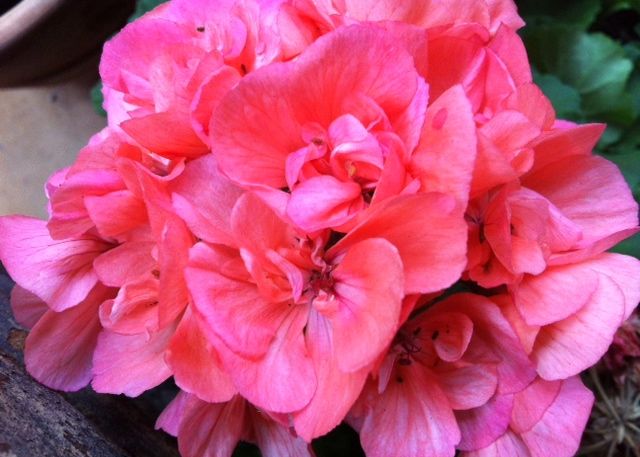
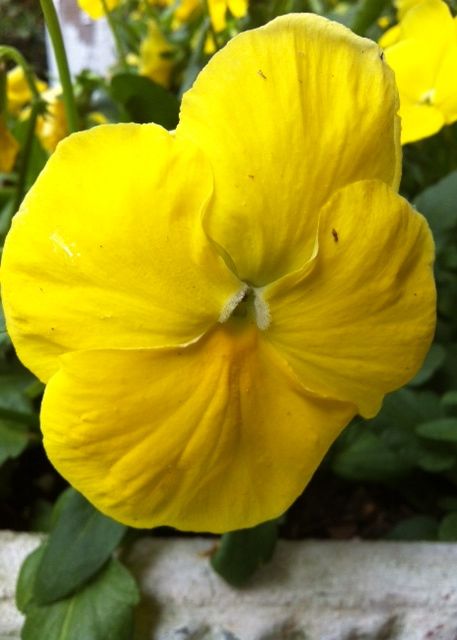
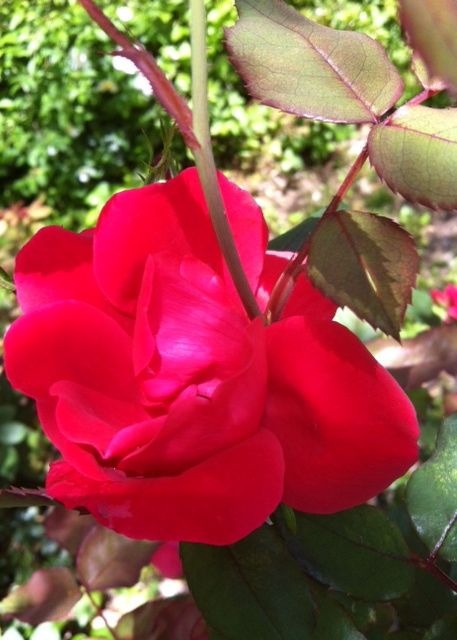
Then I saw the Wordsmith Studio photo prompt for this week, and I thought, yes; that’s what I’ll do. I’ll go out in the yard and photograph a few flowers, as the prompt suggests.

What do flowers have to do with tragedy? Not much, maybe, except that they remind us there is beauty in the world in spite of evil. That the seasons come round and the earth renews itself in spite of the awful ways we treat her or the unspeakable things people sometimes do to each other.

So if you need a pronoun refresher, I suggest you visit the Purdue Online Writing Lab‘s excellent pronoun primer.

Right now, I hope you’ll enjoy these blooms and let them lift your hearts a little.

What gives you comfort when things seem out of control?

Polio Summer

In the United States, the 1952 polio epidemic would be the worst outbreak in the nation’s history, and is credited with heightening parents’ fears of the disease and focusing public awareness on the need for a vaccine.[20] Of the 57,628 cases reported that year 3,145 died and 21,269 were left with mild to disabling paralysis. — Wikipedia

Most of those polio victims were children. I can’t attest to the accuracy of these numbers, although they are documented. But I can attest to the fear.

I was reminded of it when I read an article the other day about Mark O’Brien, a poet who was stricken with polio at age six and confined to an iron lung for the rest of his life. He died at 49. (His story inspired the movie, The Sessions.) As I read, the memory of a particular summer in our small town came flooding back. I’m not sure it was 1952. It may have been a different year, but it was our personal summer of terror and dread.

It was probably a typical Mississippi summer–the smothering heat, the mimosas in bloom, the late afternoon thunderstorms that didn’t cool things off but made steam rise from the pavement, the attic fan that barely stirred the hot air inside the house.

Ordinary, until children started becoming ill at an alarming rate.

As panic spread, my parents kept me out of crowds and away from swimming pools. My best friend’s younger sister and brother came down with severe cases. My friend did not. Her sister was transferred to a Vicksburg hospital, designated a regional pediatric polio center, where she would receive more treatment and therapy. Just as many other children did, that little girl spent weeks there, far from home. She would have been about five years old. What must that have been like for her? What was it like for her mother and dad, to be separated from her?

Boy and Vaccine Syringe / Photo by Sura Nualpradid / Courtesy of freedigitalphotos.net

Boy and Vaccine Syringe / Photo by Sura Nualpradid / Courtesy of freedigitalphotos.net

I had other sick friends, too, and there was little anyone could do to help. My mother suggested I share some books with a friend who had a fairly mild case of polio but still faced a long recovery. So I gathered books, and one of my parents delivered them (whoever took them would not have entered the house). I didn’t know my books wouldn’t be returned. They were burned.

The worst case, the one that affected all of us more than any other, was a young boy so severely ill that he required an iron lung. I remember our prayers for him at school and in church. I remember the day the teacher told us he had died. In my memory, it was September; we were back in school, and I was sitting in art class. Dead? My reaction was selfish. I was terrified. A child could die? Old people died, not children.

I didn’t get sick that summer. My friends got well, eventually. My best friend’s sister was left with scoliosis that would plague her for the rest of her life. None of us would ever be the same. Whether we were directly touched by polio or not, we learned some hard lessons: that our parents, no matter how good they were or how strong or how faithful, no matter how much they loved us and cared for us, couldn’t always protect us from harm. That our bodies were frail. That disease and death were real and close, lurking in the innocence of a shared sip, a touch, the water in a swimming pool.

In 1955 the Salk vaccine was introduced. A godsend, but it was too late for many.

Thinking about that long summer has been interesting. I’m surprised by the details I remember, like the burned books. The memory of the fear is so real it’s almost visceral. I’m surprised, too, by the things I feel I’m recalling incorrectly. (Was the child who died a boy, or was it really a girl? I can’t say for sure.)

Memory is a slippery thing. It warps our stories and makes liars of us, even when we’re trying our best to tell the truth.

Do you have a memory that eludes you, that’s difficult to recall truthfully? How do you feel about the fictions our minds create about the past?