Road Weary

Road-weary and hungry, we stop at a chain restaurant just off the interstate, a madhouse on any Sunday after church, but we pull in right behind a tour bus full of fossils from another age. All of them wear nametags, hats, and polyester/no-iron outfits fit for long hours on the bus. It’s clear they’ve worked out a restaurant plan of operation: some line up to order, others scout out the best tables, while our stomachs rumble behind the slowest of the slow who can’t make up their minds or must ask the girl at the cash register questions about the menu: whether the foccacia is too crusty, the artichokes on the sandwich soft, the mayo low in saturated fat.

When we finally sit down, they’re all around us: one little lady with blue-black hair, wearing her trendy FENDI sunglasses; a man with a hearing aid who shouts his complaints at his companions; another large man who, blocking the hall to the restrooms, responds loudly to my “excuse me, sir” with “Well, I was trying to get there myself, but you go right ahead.” Nothing gallant about him, no trace of the dashing young man who might have made a young woman’s heart flutter.

My back hurts from driving, my knees ache, and I think these are signs of what’s to come, the time when getting on and off the bus will be enough for one day, when my friends and I—the ones who are left then—will crowd onto the coach the brochure described as luxurious and  head for some far-off, interesting place: Rock City, maybe, an exhibition at the Fernbank in Atlanta, a play in New Orleans, the coast casinos.

I wonder how they pass the time on the bus. Do they relive the old days? Do they compare their aches and pains? Can they still see well enough to read or knit? Do they plug in their Walkmans—or maybe even their iPods—and daydream to the music? Or do they sleep away the hours they have left until the next destination, or until, all too soon, the bus pulls in to the parking lot at home, wherever they’ve come from, and they all go their separate ways until the next time, when the destination will be someplace truly exotic, a place they’ve always wanted to see before it’s too late.
Potters, Clay, and Kiln

I took the header photo for this website at Hambidge, an artists’ retreat center in north Georgia that has been temporary home and respite for me and for a large number of other writers, visual artists, potters, composers—artists across the spectrum of creativity.

During my first stay at Hambidge, there was a firing of the anagama kiln. I knew about kilns, of course, the ovens potters used, but I had never seen anything like this one. This kiln, shaped like a huge concrete igloo, sits halfway up the mountain on the Hambidge property. Over three days one weekend in April, potters came from all over and brought their wares to be glazed and fed to the rapacious, fire-breathing beast.

Once the pieces were loaded and the fire started, the potters took shifts around the clock at the kiln. They fed wood to the fire and kept watch all through the night on Saturday until, on Sunday morning, the kiln door was “bricked” shut, and the artists went back to their other lives. They would return the following weekend to see how the kiln had worked its magic—or its destructive, fiery force—on their works of art.

The following Saturday, mist shrouded the mountains when we walked up the long hill to the kiln. The potters—and others, like us, who were either curious or already knew what was about to happen—gathered on either side of several long tables lined up outside the kiln shelter. The bricks were removed from the kiln door, and someone brought out the first finished pieces (the last to go in—“the first shall be last”), dusted off the ash, examined them for flaws, and handed each one to the first person in line who placed it on the table in front of him. And so the pieces passed down that line from one pair of hands to another. The first table filled, and the next, while my husband and I waited far down the line until some of the last works out of the kiln finally made it to us. To hold someone’s unique work of art still warm from the kiln, to turn it in my hands and feel its heft, its curve, its texture, its smooth glaze before I placed it on the table was a remarkable experience. The tables filled to overflowing with these transformations of clay into finished work. Most were whole; some were not. They didn’t withstand the heat, or the clay was flawed or not worked correctly to begin with, and so the piece cracked or broke in that furnace. The potters, interestingly enough, philosophically accepted the broken with the whole. Both are part of their process.

I learned something about my own art that day. I need a fraction of the faith of the potter. My stories always go through the fire, an emotional, gut-wrenching process, before they’re anywhere near fully formed. Some of them come out whole and warm in my hands; others are irreparably flawed. Those may be the ones from which I learn the most.

Dancing

balletslippers

En pointe

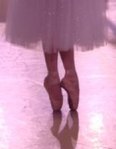
Last Saturday night, I watched my granddaughter dance in a performance of Beauty and the Beast. She is an exceptional dancer—she really is, and not just because she’s mine—and she’s really quite beautiful. At twelve, she is incredibly strong, precise, and graceful en pointe. And she’s an actress, too; she understands the necessity of portraying emotion through movement and expression. She is the dancer I wanted to be as a child but never could have been, not just because the nearest dance classes were twenty miles away. I was not exactly a graceful child.

But I dreamed about it. When I was little, I wanted to be a ballerina. My inspiration was a coloring book, of all things. I don’t remember where the coloring book came from; maybe the local dime store that Mr. Vester Page owned. I went there often. Usually, it was Daddy who would take me to buy a treat, some trinket: balloons, I loved balloons, or jacks, or crayons or watercolors. I loved that store, and the mynah bird he kept in the back that whistled and squawked, “Pretty bird!” “Pretty girl!” So this particular time, the summer before I turned six, there must have been that coloring book. I can still see the simple, stark line drawings of dancers in what I now know are “positions,” ballerinas in tutus with flowers or tiaras in their hair, male dancers who looked like princes out of a fairy tale. But they were motionless, frozen on the pages. What I don’t remember is how I learned that these frozen images represented so much more. But somehow, I knew that those poses needed to be translated into movement. And so I hatched a plan.

I recruited a few neighborhood kids to participate in my ballet. We studied the pictures in the book and practiced the poses. There was no continuity of movement, just those static positions. We would stage one, stop, then another, stop. Rearrange ourselves and start again. And because there was probably no boy in the neighborhood big enough or strong enough (or gullible enough) to be coerced into doing it, I recruited my daddy to play the prince: to lift me up in that final, dramatic pose that signaled the happy, triumphant ending.

The performance was to be on a Saturday evening, after supper but before sundown, in our front yard. It was steamy hot, late summer. I remember wearing a yellow halter sundress that was as close as I could come to a tutu. I was nervous, excited. And then, just before suppertime, my mother declared that I had to wash my hair. Before the “ballet,” not after. The next day was Sunday, after all, and she wanted my hair dry before bedtime. This was back in the days of the attic fan, which my mother was convinced caused me to catch cold if I slept in its draft at night, and going to bed with wet hair would court disaster. Usually, I could wear her down, but not this time. She would not give. She washed my hair and put it up in pin curls.

So at “showtime,” I appeared in my pretty yellow dress with my hair in pin curls and, most likely, with my eyes red from crying. I was mortified, but stubborn. I would have my ballet, no matter what. And I did. It must have lasted all of ten minutes—we awkward little kids using the coloring book as the guide for our “dance,” and Daddy lifting me high in the air at the end. No music. A little clapping.

That was the beginning and end of my dancing. Within a year, we would have a piano in the house, and that would turn out to be the right artistic expression for me; it would become my graceful movement. I wanted this grandchild to take piano, to excel at it. And she did, but it just isn’t her thing. She’s a born dancer. And when I look at her in a certain light, although she looks so much like her beautiful mother, I can see a little of me in her. And  maybe the spirit and the love of the dance I see in her was born in me, a long, long time ago.