We Don’t Have to Know Everything

What do you do with someone who won’t behave?

This person is secretive, aloof, moody. She’s keeping me up nights and interfering with my novel-in- progress. She’s the character who “vants to be alone!”

Her name is Robin. She’s a twin. An accomplished photographer. She has dark hair and green eyes, she’s twenty pounds overweight, she’s married with two sons. Her marriage is in trouble. Her twin sister has died, and she carries a terrible secret.

All these complications in her life, and yet, even after excellent feedback at a workshop, I remain stumped by what Robin desires and what will keep her from getting it.
Photo: Andrew Seaman on Unsplash

So I start over at the beginning, revising as the story seems to lead me. I try applying a rubric the workshop leader shared. It’s a good tool to get a handle on what a story is about (can you say it in a sentence?), determine what the “container” is (time frame and place), and sketch out the main characters and plot points. The rubric helps, but I’m not there yet. I’m still worried about not knowing clearly who Robin is and where she’s going.

I have to confess I’ve never been big on plot points, but I’m learning. I tend to let the story evolve, which means I may do more work than someone who is able to plan the story (or book) out, start to finish. Sometimes, because of my tendency to “pantser” rather than plot, I feel inept as a writer.

Many writing experts contend that we should know everything we possibly can about a character before we begin. But a fine teacher of writing and an exceptional fiction writer in his own right, David Jauss, takes the stance that we don’t have to know everything. In fact, Jauss says it may be preferable not to know; not knowing every detail ahead of time may lead to richer character-ization as we discover things about characters as we write them.

What a relief!

What Jauss says doesn’t absolve me of all responsibility where the story is concerned. I can’t put the writing on automatic pilot. (Wouldn’t it be interesting if we could? But I don’t trust the recent developments in AI to do the job.) But Jauss’s take allows me the freedom to write about this character and her circumstances, to write into her, and see what unfolds. Maybe I’ll discover along with her how she ticks, where she’s headed, and how she’ll get there.

So here we go, my make-believe friend, Robin. Let’s see where the words on the page take both of us.

How do you handle your less-than-cooperative characters? Are you a “know everything” writer or one who goes with the flow?

Open the Doors. Walk Right In!

We talked recently about the importance of ridding a story of whatever isn’t absolutely necessary and/or doesn’t advance the story. This “excess” can be anything from losing a line of description to cutting out a character. Or a scene. In the case of novels, entire chapters.

But once we’ve reduced a story to its bare bones, what’s next?

We look for opportunities.

A few years ago, in a fiction workshop at The Lighthouse Lit Fest in Denver, I had the opportunity to sit down with an author I admired to talk about the opening pages of my novel. That hour was golden, but it was also hard. What I’d thought was a pretty good start had lots of growing to do.

Image: Jan Tenneberg, Unsplash

Most of his comments—scrawled in the margins beside a line or two of underlined text—said simply “Open this door.” He talked about being alert to a range of possibilities to go deeper into a character’s psyche, to make description more visual and significant to the story, to open up the plot in a different direction.  

How was it he could see those things when I had not? I’ve decided it’s a skill that comes with practice.

As you read through a draft (preferably aloud), be open to possibilities. Be aware of anything that needles you, of passages that feel somehow incomplete or “off,” of words or phrases that nag you. In my experience, sometimes there’s only a vague uneasiness; I can’t say right away “what’s wrong.” It can feel so urgent to “finish” and get a story out into the world that it’s easy to ignore these signs. Chances are, they won’t go away on their own. And the story won’t fix itself.

Here’s an example of what I mean by opening doors, taken from a story I’m still working on, “Fast”:

Paul witnessed his father’s hard life as the pastor of two, sometimes three rural churches at a time. His shortest tenure while Paul was growing up was two years, the longest ten; a cycle that repeated throughout his father’s life.

Became this:

Whenever someone asks how he came to be a minister, Paul likes to say he was called. It’s what his father said, and Paul believed it. Why else would a man choose to serve two, sometimes three poor, rural congregations at once, moving every few years to a different set of churches, a different set of people and problems? Paul witnessed the toll it took—never enough energy or time to go around, never enough money. Paul was eighteen and about to leave for college when his father told him he had one piece of advice. He swept his arm around the shabby office in one of those rural churches. “Whatever you do, don’t do this,” he said.

What’s the difference—beyond more words?

What works for you when it comes to “fleshing out” stories? I would love to see your comments.

[This post originally appeared at Story Circle Network, February 10, 2023.]

A Little Fiction: All Fall Down

Shelly and Hank had planned this camping trip as an attempt at getting back together. It wasn’t working. He was late picking her up, the drive took five hours instead of their usual three, and when they finally found a space to camp, they argued over where to set up the tent.

She dropped the side of the tent she was holding and walked away. “All right, fine. You deal with it.” She headed for the river bluff. She thought Hank would come after her, but he didn’t.

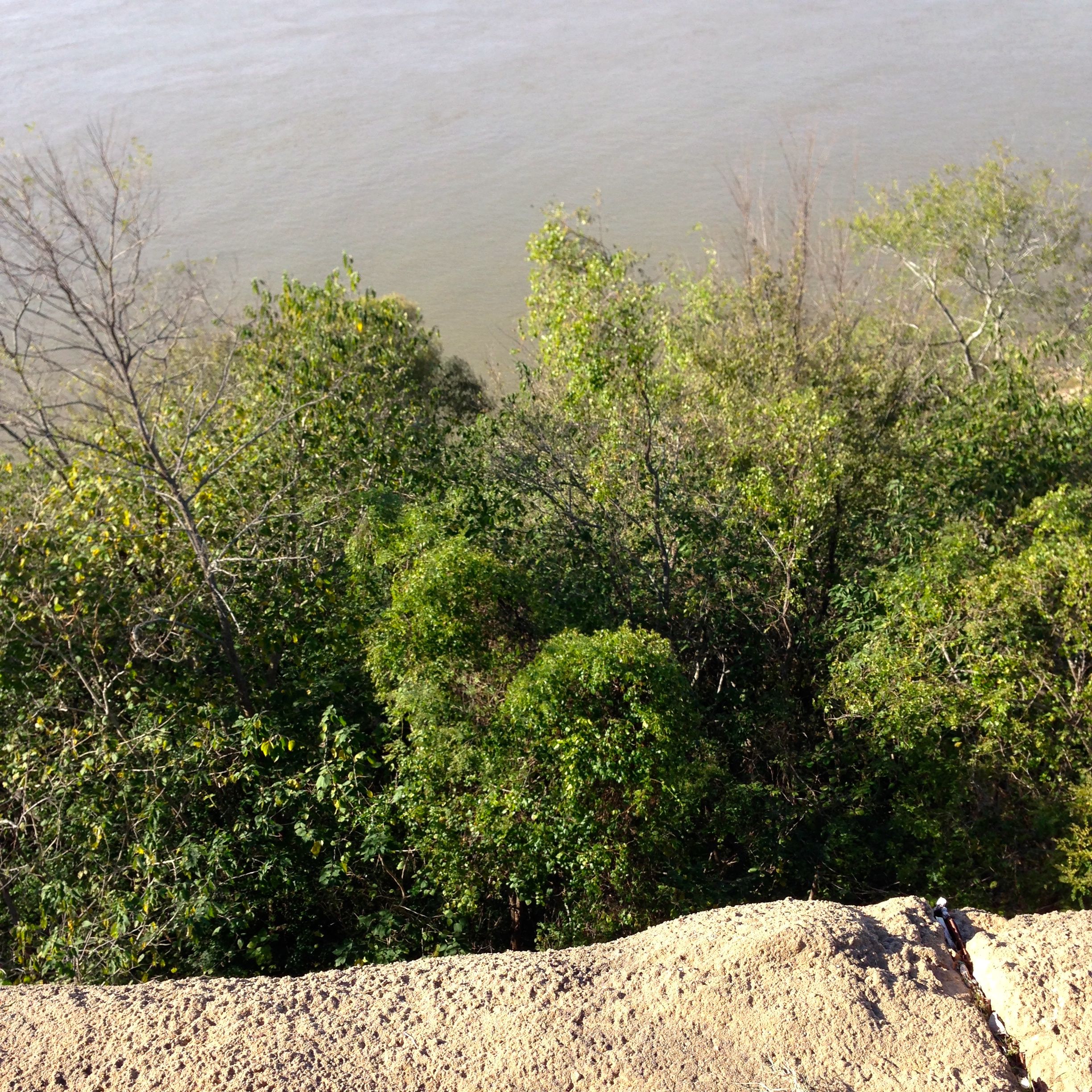
riverview

the Mississippi / Gerry Wilson

The bluff dropped steeply away to the river, maybe thirty, forty feet. Willows clung to the banks and leaned out into the sky like filmy, green parachutes. Shelly walked as near the edge as she dared and considered climbing down. She had always wanted to do it; why not now?

She looked for a place that wasn’t a sheer drop, where there was brush, or outcroppings of stone. She eased over the edge and grabbed a sapling, then another, her breath coming hard, thought I can do this, until a branch bent and snapped, rocks skittered and fell, and she slipped, clutching at mud and stone and brush. She slid all the way down, landed on the narrow bank, rolled towards the rushing water, clawed at the mud to drag herself back. She lay still and assessed what hurt: her head, her right shoulder, her right ankle.

She sat up. The knees of her jeans were torn and stained with blood, her hands scraped and bloody, too, and caked with mud. She unlaced her hiking shoe and took off her sock. The throbbing ankle was already swelling and turning blue. Jesus. She pulled the sock back on and forced her foot back into the shoe. Pain jolted from her ankle to her thigh.

“Hello?” she yelled. “Hank? Anybody?”

Nearly five o’clock. The bluff cast deep shadows on her and on the river. Maybe  twenty yards away, a sandbar extended out into the water. She’d be more visible from there. She tried to stand, but she couldn’t bear weight on the ankle. She crawled far enough out onto the sandbar to see the top of the bluff. She called out again, “Hello? Hello! Down here! Help me!” But the day picnickers and hikers would have gone home by now. The overnight campers, like Hank, would be settling in. On the river, no vessels—an old-fashioned word her father, a retired Navy man, would have used—this time of day, no kayaks or canoes, no pleasure boats.

The sky was a clear, deepening blue. The wind out on the sandbar went suddenly chilly. The rising moon had a corona of light. That was supposed to mean something: a sign of rain? Bad luck?

Shelly washed her stinging hands and splashed her face with the cold river water. She struggled to her feet and tried her weight again on the throbbing ankle. She had to get off the sandbar. She hobbled the length of it before she dropped to her knees and crawled back to the shelter of the bluff.

No way she could climb. She’d be fine right there, a little banged up and wet. Hank would come looking for her. All she had to do was wait.

###

This piece of flash fiction is headed over to Yeah Write, where writing events abound. Writer friends, be sure to check them out!