Consider the Two-headed Coneflower: Character and Oddity

There’s a two-headed coneflower in our garden. A hardy perennial, the coneflower grows abundantly around here. It withstands the heat and drought of long Mississippi summers, withstands neglect (I am proof of that), and practically grows itself.

The coneflowers and their little rudbeckia cousins (black-eyed susans) all surfaced early this year because of the mild winter, but this particular plant outgrew all the others. It’s a bit of a freak. For weeks I watched it grow taller and taller and waited for it to flower. Even its foliage looked different, and I decided maybe it wasn’t a coneflower at all but a weed. At one point it looked suspiciously like a thistle, and I almost pulled it up. When it finally bloomed early in April, it bore these two conjoined flowers on one stem.

So here’s the metaphor; I bet you were expecting one, weren’t you?

The flower’s oddity, its two-headedness, reminds me of how I develop fictional characters. Right now, I’m dealing with a character who’s very hard to like. He’s deceitful, cruel, and violent. He’s a drunk. He’s a racist. He’s a dastardly fellow if ever there was one. As I revise the novel, though, I find myself looking for reasons why this man is the way he is. What caused him to turn out this way? If I asked him, what would his excuses be? I’m looking for his secrets, his oddities, his other side, his vulnerability, his soft underbelly. Surely he must have one. When I find it, the character and the book will be richer for it.

Even after heavy rain over the last few days, that odd coneflower is still there. A bit bedraggled, but hanging on. The other plants, about a third its size, aren’t even close to blooming yet. That’s how I feel some days when the writing doesn’t go so well or there’s no time to work. Maybe that strange, tenacious flower is a gift; it’s here to teach me to look for what sets a character apart. To persevere, no matter what.

What are your favorite tricks for getting to know your characters? I’d love to know. Please post your comments!
A Platform Is Something You Stand On

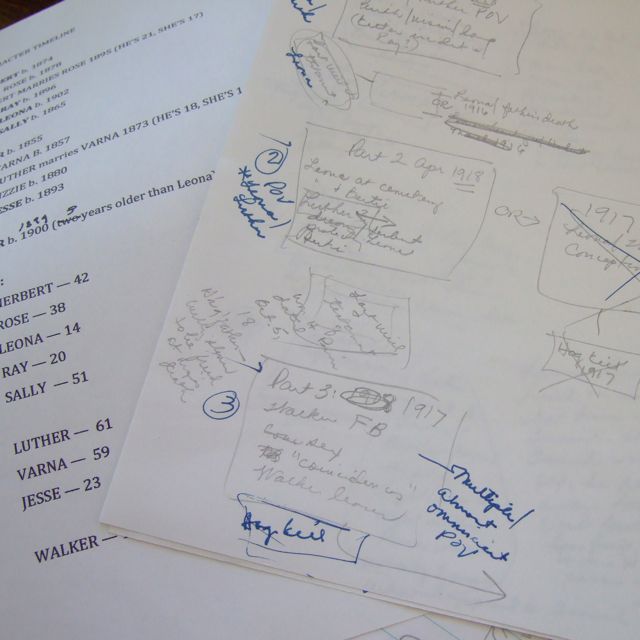
writing notes

I’m writing this post as an assignment after being away from the blog for too long. Every time I’ve logged on lately and have seen the dates of my last posts, I’ve felt embarrassed and a little panicky. Should I give up the blog entirely? How will I carve out the time to write frequently, or at least regularly, without neglecting what I feel I really ought to be about, and that’s revising the novel and working on short stories?

Seeking answers, I’ve been participating in Robert Lee Brewer’s Platform Challenge during the month of April. Robert has created a series of exercises intended to help writers wrangle their online presence into shape. In the process I’ve done more Facebooking and tweeting and read more blogs than I could have imagined. It seems a “platform”—significant interaction with others (on the Internet and otherwise) with the purpose of building a following—is necessary these days, even before you publish a book.

The challenge has been fun and revealing. Here’s what I’ve learned about myself: I’m afraid I’m something of an Internet junkie; I don’t know when to quit or how to protect my writing time. That’s an important discovery. Along with learning how to connect with others, I need some self-discipline!

Robert’s post yesterday on how he handles social media helps. He makes a “task list” for his day and sticks with it. He allows himself social media time in 15 minute increments scattered throughout his day, and only when he’s completed a task. That sounds reasonable to me. I’ll give that a try.

Meanwhile, a new short story swirls in my brain and won’t leave me alone. The novel-in-progress nags for attention. My other lives—as wife, grandmother, chief cook, housekeeper, gardener (not to mention reader)—call me away from the writing work. And it’s spring, about the only time of the year when it’s pleasant to sit outside and read a book or daydream or let that story idea take shape. I live in Mississippi. Another six weeks, and you won’t be able to breathe when you step outside.

So here’s my resolve: I plan to return to the blog on a regular basis. I’ll try to make my posts more relevant to the writing life I live. But I will also try to accomplish this on a schedule, along with generally managing my online time better.

Visit Robert Lee Brewer’s blog, My Name Is Not Bob. You’ll find his April challenges— creating a platform and also a poetry challenge for the month of April (April is poetry month, after all)—and lots of other interesting information for the writing life there.

If any of you who read this have comments or suggestions regarding time management, I welcome the conversation! Now let’s get off the ‘net and go to work. Cheers.

The Rigors of Revision

Over the past month or so, I have revised my first novel Whatever House for the umpteenth time. Seriously, I’ve lost count. I had put it away nearly a year ago, having given up on the agent search (Who has time? Who wants to deal with the rejections?) to move on to other—I thought, I hoped—better work.

Back in the spring, my husband and I were at Hambidge (a wonderful artists’ retreat center in the mountains of north Georgia; if you don’t know about it, check it out) for a couple of weeks. One night after dinner with the other artists in residence, he called me out: “You talk about writing the second book and having ‘one in the drawer.’ Wouldn’t it feel a whole lot better to say that the first book is ‘out there’ instead?” He was right, of course. That first novel, like a Cinderella stepchild, was languishing, wanting attention.

So I got back to work on it. I cut some of my “beauties,” the words and paragraphs, even whole scenes sometimes, that it’s hardest to let go of, especially the metaphors that seemed brilliant when I first wrote them but make me cringe now.  I added: details, narrative, dialogue, scenes. I increased the emotional stakes for the main character. I tried to make the opening “sing” to draw the reader in. My husband read it. Again. For the umpteenth time. A writer-friend I met at Writers in Paradise is also reading it. We’re reading for each other, and that’s a very good thing. Other minds, other sets of eyes, are essential to this process. No holds barred. Tell it like it is. (I’m venting  my cliches here!)

Whatever House is now a svelte 91,000 words. It was a whopping 114,000 when I began this revision. We won’t talk about how long the original draft was. That’s a LOT of stuff on the cutting room floor. But the book is tighter and richer, the main character is stronger, and maybe, just maybe, it’s more appealing to readers.

Whatever happens, I learned much in the process. Thank you, my kind and diligent critique buddies. I owe you. Big time.