Ah, Thirteen!

Finally, a teenager. What was different? Very little.

I still looked immature. No makeup, no pierced ears. None of that.

One vivid, intimate detail stands out. The summer I was thirteen, my mother finally bought me a bra, a strapless one to wear under sundresses. I didn’t even need it, really, but I was so distressed over nothing happening on that front that she gave in. The worst part was that she made me model it for my dad. I think she saw it as their celebrating a rite of passage with me. I was mortified, and I think he was, too. I believe it was the beginning of a distance between my dad and me.

Daddy/daughter/beach

I love this photograph. Look at what happens to our shadows.

It’s interesting to think about what happens in the dynamic between father and daughter. My dad and I had always been close, but I felt him pulling away. Certainly no more sitting on daddy’s lap at this late stage. There were hugs, good ones, and kisses on the cheek. But he seemed keenly aware of the fact that I was becoming a young woman.

What he and my mother didn’t know was that my best friend and I spent many hours on Saturday mornings watching out her window for the older boy who lived next door. My friend’s upstairs bedroom overlooked his yard. I spent every other Friday night at her house, and we’d be up early, hiding behind her curtains, watching and waiting for him to come out. He was golden: tan, blond hair, blue eyes, a dazzling smile. A high school boy! Usually, he cut the yard on Saturday mornings. We lived for warm days when he would mow without his shirt. We’d be in spasms of giggles, daring to peek out from behind the curtain, living on the edge of being discovered, in many more ways than one.

Did you mature early or late? How did that timing affect relationships with your parents? Your friends?

“Ah, Thirteen!” continues the memoir series prompted by Jane Ann McLachlan’s October Memoir and Backstory Blog Challenge. To access previous posts, see Recent Posts in the right column.

Age Twelve: The Great Void

Around the age of eleven or twelve, a kind of cleansing took place, and my memories are as sterile as the old house became when my mother tried to make it new.

Not long after my grandfather died, my mother decided to remodel the house. Looking back, I suppose it had to do with wiping out those years of sickness and impending death, but she went for a modern look: more or less Danish modern inside a red brick cottage built in the 1920s. The ruffled organdy curtains came down, replaced by sheers. The oil stove, our lifesaver during the ice storm, was removed and the fireplace sealed off. My grandmother’s old-fashioned dining room furniture, including the table I had played house under since I was a toddler, was carted off and replaced by starkly modern pieces. I remember everything as being beige: beige carpet (that was new, too, over old hardwood floors), a beige couch, beige barrel chairs . . . Daddy installed a big, ugly window AC unit in the living room. He bought a television set, and although what we saw on the screen looked like snow, we sat glued to it. Milton Berle. The Howdy Doody Show. Roy Rogers. Kukla, Fran, and Ollie. Ed Sullivan. (There’s a great list of shows of the 1950s at Wikipedia.)

My room changed, too: the wallpaper printed with cabbage roses came down, and the walls were painted a pleasant shade of pale green. Mother had flowered chintz curtains made and a built-in window seat where I loved to curl up and read. I was changing, too, but not fast enough to suit me. I was behind other girls my age who were blossoming. I was still a straight-up-and-down girl, no curves for me yet.

My grandmother’s banana pudding recipe
The ledger is dated 1924.

During those years, my grandmother, not my mother, was the primary cook in our house. She was one of those instinctive cooks–a pinch of this, a handful of that–and she never used a recipe she didn’t modify. I found the handwritten recipe above in a small ledger she kept sometime after the mid-twenties. The ledger contains other recipes and notes and meticulous records of her sales of eggs, milk, butter, and cream to her neighbors. That’s how hard times were. It was the depression, after all. By the time I came along, the cow was gone, and although there are photographs of me toddling around the yard, chasing chickens, I don’t remember them. The ledger is falling apart now, and all the pages deserve to be scanned. They tell the story of my grandmother’s hard life, which may help to explain why life with her became difficult as she grew older.

My mother made over our house, all right, but she didn’t succeed in changing the dynamics of the relationships. My grandmother remained more the mistress of the house than my mother was, although my dad was the true head. It was as though my mother had never grown up; my grandmother treated her like a child. To give you an idea of how complex things were, I called my mother “Mother” and my grandmother “Mama.” At times it did seem like I had two maternal parents. And as I approached adolescence, the complexity of three generations of women under one roof began to take shape.

Do you understand the dynamics of your growing-up household better now that you have an adult’s perspective, or are they still a mystery to you? What questions do you wish you had asked when you had the opportunity? 

This is entry twelve in Jane Ann McLachlan’s October Memoir and Backstory Blog Challenge.

The Not-Eleven Memoir: The Star!

This post should be about age eleven, but I’m breaking the rules of the October Memoir and Backstory Blog Challenge. It turns out that the year after I turned ten (it’s my eleventh year, after all, so maybe that counts for something) was a big one in terms of memorable events. The ice storm. My grandfather’s death. But it was also the solo recital year, and I have to write about that.

First, a little music history: I had started piano lessons the summer before I turned six with a college student who had allowed me to “play by the numbers.” When my real teacher, Miss Vera, took me on in the fall, I didn’t know one note from another, so she started over. If you’ve been reading these posts, you know about the piano Santa brought. Daddy played some by ear, and I was picking out tunes before I started lessons. In that house, we loved music! There were the radio shows my parents listened to, but they didn’t own a record player until later. By the time I was seven or eight, I did. Among my favorite records–all 78s–were Peter and the Wolf and Rusty in Orchestraville (a narrative that introduced all the instruments of the orchestra). There were others, I’m sure. I took to the piano and I had a good ear, which helps account for “learning ” music without being able to read it.

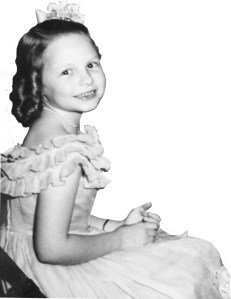
The first recital dress my mother made

But I progressed. For my very first piano recital, my mother made a dress: pale blue organdy with triangles of ruffles on the skirt and a band of ruffles across the shoulders. At the point of each of those ruffled inserts on the skirt was a rosette of tiny organdy rosebuds tied with narrow satin ribbon, like nosegays, all made by hand. I remember watching Mother make them; those rosebuds involved a tedious process of rolling the edges of the fabric between her fingers. What a labor of love that dress was, and how I wish she hadn’t let someone borrow it! We never got it back.

The ruffles around the neck are obvious in the photo, and if you look carefully, you can see the top of the ruffles on the skirt.

Solo recital

When I was ten (going on eleven by a few days), I gave a solo recital. That’s right. All by myself. An older boy played a duet with me (a boy who was teased unmercifully for his talent and his “sissy” ways), and Miss Vera herself played second piano on a rousing arrangement of “Turkey in the Straw.” I was a hit, and I would continue piano lessons through the ninth grade. This recital dress was pale pink, by the way. And those are tiny artificial flowers sewn on by hand. My mother didn’t consider herself to be creative, but I believe she was an artist.

What music do you remember? Did you learn to play an instrument? Did you love it or hate it?