Autumn

Autumn isn’t so much a season here in the deep South as a blink, a held breath between our unbearably hot summers and what passes for winter.

This year has been different, though. We’ve had pleasant days and cool nights since September (granted, with a few summer-like days thrown in). By Wednesday, we’re in for our first shot of “arctic” air: a cold front is headed our way, promising to drop our night-time temps into the twenties. The maple tree in the photo below is now bare, and the ginkgo trees down the street are not quite at their peak, but in a day or two, they’ll drop their leaves in a chorus of yellow, all at once, a carpet on the ground.

Image

The glorious season

I was already thinking about the change of seasons before I read the Wordsmith challenge. I love this time of year. It’s such a glorious season: the riot of color, a certain quality of light that renders everything sharper, the clean air. Autumn, for me, is almost one of those “thin places,” where the temporal meets the spiritual in an unexpected way. So why am I melancholy, I’m wondering.

And then: this memory

My mother died on an unseasonably chilly October night. She had been sick for three years, off and on, but the “terminal” aspect of her illness had lasted only a couple of weeks. I say only because I’d been told it could take months for the cancer, which had spread to her lungs, liver, and brain, to kill her. What awful weeks those were. Once I’d known her prognosis, I’d arranged to move her to a local hospital so I could more easily take care of her. All the doctors could do was try to alleviate her pain.

I remember asking a friend to bring my younger boys to visit her in the hospital. (My two older sons were already away at college.) I thought it might lift her spirits. I helped Mother “primp”: I brushed her hair, put on a little rouge and lipstick. She looked awful by that time, and there was no disguising it, but for the children, she wanted to try. By the time I was done, she was exhausted. The boys came, and the visit was awkward, silent. Mother tried, she really did. But her eyes already seemed to look far away at something or someone I couldn’t see.

A week later, my mother was dead. I sat with her in the last hours. One of the nurses told me to talk to her, to tell her it would be all right if she left me. And so I did. I told her it was okay to go, that my dad was waiting for her, that I would be all right. My sons, whom she loved dearly, would be all right. Her eyes, half-open, seemed to register nothing.

I had never been in the presence of death before. Oh, my maternal grandfather, had died in the house when I was ten, but that was different. This time, I was in the room. Up close. A friend came to wait with me. I’d been told it would happen soon. I sat there, listening to my mother’s breathing that had gone shallow now, such a relief after the past two days when every breath had been a terrible struggle. And then, suddenly, the absence of breath. Silence.

The nurse came and confirmed what I already knew. She and my friend left me alone with my mother for a few minutes. I was calm, struck only by how quiet it had been at the end, as though death was the most natural thing in the world, far less brutal that the slap on the bottom of a newborn.

After the paperwork was done, about midnight, I walked to my car, alone. Cold, a gorgeous full moon shining. I would have to tell my children. I would have calls to make, and arrangements, but all of it could wait until tomorrow. I did not cry. I had already done a lot of crying in the previous days and weeks. I breathed in the chilly air. The moon and the beautiful night seemed like signs: of life and joy in the midst of death and sadness. Of gain and loss. Of earth and heaven, joined.

So maybe that explains my love of this time of the year, even though it’s tinged with nostalgia. I love the passage of all the seasons, reminding me of the stages of life and how precious it all is.

What is your favorite season? How does it feed your memory and your stories or poems?

Memory, Revisited

Last October, I participated in what I thought would be an impossible challenge: to write a memoir piece for each of the first 25 years of my life. Jane Ann McLachlan has launched the 2013 October Memoir and Backstory Challenge, and I’m having a go at it. This year, each week has a theme, and because October is such a busy month, there may only be a post or two a week. But I hope you’ll join me here and read whatever surfaces—because that’s exactly how it happens for me: the stories “surface,” they rise out of deep memory and time.

The first week’s theme: a childhood memory

IMG_1272
Second grade scrapbook

I was surprised, reading through last year’s posts, that I’d neglected to write about one of the more traumatic events of my childhood.

I was a sickly child. I won’t go into the details, but by the time I was six, the doctors recommended that my chronically infected tonsils be removed. That would solve all my problems, they said.

October. I was already into my second grade year, but the surgery couldn’t wait. So we were off to the big hospital twenty miles away. I don’t remember being afraid. I remember the operating room lights, the smell of ether. I remember waking up with a terrible sore throat, sucking on ice chips, not crying because crying made it hurt even more.

The evening after the surgery, something went terribly wrong. There was blood, lots of it. A flurry of nurses, another trip down the long hall, rushing this time, the lights, the mask closing over my face, and darkness. Waking again in a dim room.  I was one sick, weak little girl.

I stayed in the hospital for a long time. After I went home, I was confined to bed for weeks. I remember spending the days in my parents’ bed, so big, light, and comfy compared to mine. I was out of school for two months that fall. I ate basically the same things every day, a diet designed to cure my anemia: poached eggs mixed with cubed, buttered toast and lots of salt and pepper (the only way I would tolerate the soft eggs); a ground beef patty (made with bread softened in a little milk and another egg) at least once, maybe twice a day, with mashed potatoes (not for building the blood but because I loved them).

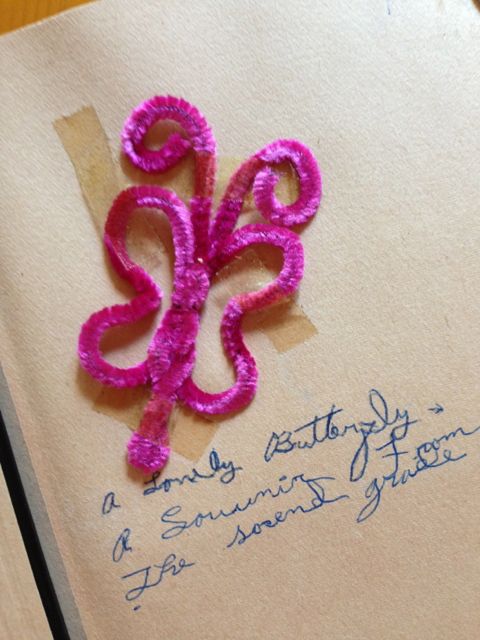
A pipe-cleaner butterfly and my own cursive handwriting

I passed the time listening to the radio, playing with my dolls, and eventually, catching up on schoolwork. My mother bought a scrapbook where I pasted all the cards I’d received, even the ones attached to flowers. My own little handwritten notes are on some of the pages—in cursive; I think I wrote in cursive before I learned to print.

My grandmother, a no-nonsense woman who loved me deeply, was the magical finder of treasures. Every day, she brought me something I’d never seen before: a china doll that had belonged to her sister; an old story book, a beetle in  a jar, a collection of pine cones or flowers out of her garden. “Surprises,” she called them.

I don’t remember gradually getting better. I don’t remember getting out of bed or going outside to play for the first time. The entire fall is a blur except for one image, as though I’d stepped outside my body: a wan little princess propped up in bed, the bright windows with their organdy curtains, the food brought on trays, the grandmother’s footsteps down the hall, bringing something—anything—to relieve the monotony of the days.

Eventually, I got well. I went back to school and finished the second grade with the rest of my class. And here I am.

Back to the present

My book group just finished a book I highly recommend: Life After Life by Kate Atkinson. In the book, Ms. Atkinson tells one story in various ways: what if this happened? Or no—what if this instead? Fascinating. Genius.

But isn’t life like that? At any given moment, with every potential choice, with everything that happens to us along the way, aren’t we shaped? Might things have gone differently? If we had gotten to the intersection two minutes earlier, would we have been the ones involved in a fatal accident? If the surgeon had been more careful; if my mother had not discovered the bleeding when she did; if I had not discovered music at my elderly neighbor’s upright piano; if I had not met a blue-eyed boy at a college dance–how different would my life have been?

What are your turning points? Do you ever play “what if” with the circumstances of your life and stand in awe of where you are and why? 

Thanks, Jane Ann, for the challenge.

Close Encounter in the P.O.: Two Soldiers

I want to tell you a true story.

At the P. O.

This morning, I stood in line for a long time in our neighborhood post office. As usual, there was only one person working–a woman who, in spite of the line, seemed determined to keep her wits about her by not hurrying. So I did some people-watching. That’s what writers do, right?

A young African American man wearing camouflage stood just in front of me. He was clearly a soldier—muscular build, clean-cut, his head shaved—and when he turned, I saw his clear, beautiful dark eyes. In front of him, a couple of suspicious looking white guys waited. One wore a baseball cap over his dirty hair (he was sending a money order, it turned out, for $57 and some cents); and the other, with his unkempt beard and beady eyes, looking like a character out of Deliverance, struggled with a box so big he had to rest it now and then on the Priority Boxes kiosk next to us.

The line grew behind me, too. I couldn’t help noticing a scruffy, bearded, older white guy when he came in. He wore a prosthetic leg and a sour expression. In pain? I wondered. Deliverance guy turned and stared pointedly at the prosthetic leg (the older man was wearing shorts).

Finally, the line moved, and the soldier in front of me was next. He had been working on a package at the kiosk, and apparently, he’d stuffed something too large into the envelope. It bulged and gapped open at the ends. The postal clerk told him he’d have to tape it up. “I don’t have any tape,” she said, nodding toward the tape for sale.

“What about that tape right over there?” the soldier asked. He was right; there was tape, in clear view on the counter.

“I can only let you have tape if you’re sending it Priority,” the clerk said. The soldier nodded, and she handed him the roll. He taped up his package, paid, and turned to go.

Encounter

Soldier Cloth by lobster 20 Image courtesy of www.freedigitalphotos.net
Soldier Cloth by lobster 20
Image courtesy of http://www.freedigitalphotos.net

As he walked out, the scruffy older man behind me said, “Soldier!” His tone sharp, commanding. I turned. Oh Lord, I thought, not a confrontation.

The young soldier turned, too, and looked at the man.

“Vietnam vet,” the older guy said, as though that was all the explanation needed. “You been in it over there?”

“Yes sir,” the soldier answered, his tone like a salute. “Twice now.”

The Vietnam vet reached across the space between them and offered the younger soldier his hand. “I want to thank you for what you do for all of us,” the old vet said. They shook hands, black man and white, two soldiers standing on common ground in our little post office. The moment was entirely theirs. Choked up, I looked away.

The young soldier went on his way, and by that time, I was at the window, tending to my mundane errand but knowing I had just witnessed something remarkable.

Some Donald Maass Wisdom

Earlier this morning, I had read Donald Maass’s column, “Seasons of the Self,” at Writer Unboxed. First, Maass reflects on his personal past, his present, his future. Then he turns the reflection to the art of writing fictional characters. Every protagonist, he says, must possess personal awareness–a clear sense of where he’s been, where he is, and where he’s going. Here’s Maass:

How does your protagonist understand his or her own evolution? Powerful characters are real people. To become fully real we need to create their personal history.

He goes on to list ways to give protagonists the sense of self that renders them human. This is good stuff; I’d say go read it right now.

Witness

So what does the Maass article have to do with what I witnessed this morning? Just this: I was struck by the fact that each of the soldiers in the post office has his own story: a past self, a present, a future. Their stories crossed in that moment, unforgettable, I would think, for either of them, or for me. I just happened to be there; ten minutes earlier or later, a shorter wait, and I would have missed it. I could invent a story now about either of them, based on what I observed. I have all I need. Whether I will or not, I don’t know. For now, it’s enough to have been there.

A challenge for you!

First, read the Maass article. Then think about the protagonist in your current work-in-progress. How does his/her story interact with the stories of others? How does such a moment of encounter impact his/her self-knowledge? Write a “fresh” encounter your character has that reveals something about his or her sense of personal history.

Or, think about your personal story in this light: How has a moment of encounter changed you? Write about it!