The Not-Eleven Memoir: The Star!

This post should be about age eleven, but I’m breaking the rules of the October Memoir and Backstory Blog Challenge. It turns out that the year after I turned ten (it’s my eleventh year, after all, so maybe that counts for something) was a big one in terms of memorable events. The ice storm. My grandfather’s death. But it was also the solo recital year, and I have to write about that.

First, a little music history: I had started piano lessons the summer before I turned six with a college student who had allowed me to “play by the numbers.” When my real teacher, Miss Vera, took me on in the fall, I didn’t know one note from another, so she started over. If you’ve been reading these posts, you know about the piano Santa brought. Daddy played some by ear, and I was picking out tunes before I started lessons. In that house, we loved music! There were the radio shows my parents listened to, but they didn’t own a record player until later. By the time I was seven or eight, I did. Among my favorite records–all 78s–were Peter and the Wolf and Rusty in Orchestraville (a narrative that introduced all the instruments of the orchestra). There were others, I’m sure. I took to the piano and I had a good ear, which helps account for “learning ” music without being able to read it.
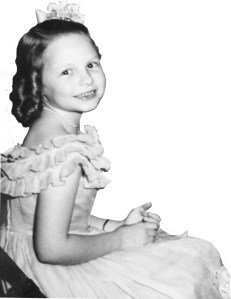
The first recital dress my mother made

But I progressed. For my very first piano recital, my mother made a dress: pale blue organdy with triangles of ruffles on the skirt and a band of ruffles across the shoulders. At the point of each of those ruffled inserts on the skirt was a rosette of tiny organdy rosebuds tied with narrow satin ribbon, like nosegays, all made by hand. I remember watching Mother make them; those rosebuds involved a tedious process of rolling the edges of the fabric between her fingers. What a labor of love that dress was, and how I wish she hadn’t let someone borrow it! We never got it back.

The ruffles around the neck are obvious in the photo, and if you look carefully, you can see the top of the ruffles on the skirt.

Solo recital

When I was ten (going on eleven by a few days), I gave a solo recital. That’s right. All by myself. An older boy played a duet with me (a boy who was teased unmercifully for his talent and his “sissy” ways), and Miss Vera herself played second piano on a rousing arrangement of “Turkey in the Straw.” I was a hit, and I would continue piano lessons through the ninth grade. This recital dress was pale pink, by the way. And those are tiny artificial flowers sewn on by hand. My mother didn’t consider herself to be creative, but I believe she was an artist.

What music do you remember? Did you learn to play an instrument? Did you love it or hate it?
Age Ten: The Hush of Ice and Death

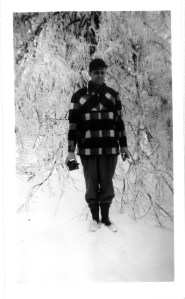
My dad after the ice storm

People might think of Mississippi and imagine almost tropical weather. Along the coast, that’s true, but in the hills of the north, the winters can be harsh, and it’s not that unusual to see snow. Snow immobilizes us Southerners, but the worst winter weather element is ice.

The winter before I turned ten, we had a terrible ice storm. I remember thinking how beautiful it was at first, that fine glazing of everything in a shimmer of ice, but as the ice got heavier and weighed down the trees, some of them bent, and others snapped. So did the power lines. The frightening sound of limbs breaking and big trees coming down went on all night long. We woke to a wonderland of white and crystal, blinding in the sunlight.

We were without power for at least a week, but we were a hardy lot. Or at least, my parents and grandparents were. I remember candles and kerosene lamps, and biscuits and scrambled eggs cooked on top of an oil stove that was our only source of heat.

Papaw and me

My grandfather’s health was failing by then. I’ve told you that I grew up in a kind of hushed atmosphere because of his illness, and as he grew sicker, there was a pall over that house. My bedroom was next to my grandparents’, and I would hear his coughing all through the night. I still have a vivid image of him, gaunt and frail, propped against pillows, smoking a Lucky Strike, listening to a baseball game on the radio.

The funeral was held at our house. It was what he had wanted; no fine church funeral for him, and there was no funeral home in town. Somebody moved all the living and dining room furniture out except for the piano and brought folding chairs in. In the dining room the casket sat on sawhorses draped in black velvet. It was February, and carnations were the flower of choice. To this day I can’t abide the smell of carnations.

I remember how we stood in the hall, my mother, my grandmother, and I, waiting to go in for the viewing. My heart pounded. I wanted to run. I was ten years old. I could not imagine death. When my grandmother leaned over and kissed my grandfather in his casket, I was astonished. How could she do that? What did it feel like to kiss the dead?

My grandfather became a character in a story about a boy, Jack, whose father deserts the family, and Jack and his mother go to live with the paternal grandfather. The grandfather–Pop–teaches Jack to smoke when he’s thirteen. After that they often smoke together. When Pop is dying, he asks Jack to bring him a cigarette, which creates a dilemma for Jack. It’s against doctor’s orders, but what can it hurt?

Here’s a bit of “Smokers” (the “I” is Jack, the grandson):

I raised all the windows in the room and switched on the attic fan we used only on the hottest nights because Mama complained that it gave her sinus trouble and made Pop’s coughing worse. When I handed him the cigarette, his hands shook so that he dropped it.

“Light it for me, Jack,” he said. “I don’t think I can do it.”

Now that we’d tricked Mama into leaving, I was getting scared. “Pop, I don’t think this is a good idea. Maybe—”

“Please, son. Just light it.”

I had gotten pretty good with practice. The old lighter flicked once, twice, then caught. I lit the cigarette and handed it to him. I had to cup my hands around his to steady it. I was surprised at how deeply he was able to inhale and exhale. Then he held the cigarette himself, balancing it between two fingers of his right hand, almost gracefully. He leaned back, closed his eyes, and let out the longest sigh I ever heard. For one awful moment, I thought he might be dying, but when he opened his eyes, they were light and alive. He wagged the cigarette at me and said, “Don’t you want one?”

“Yes sir. I do.” I lit up, too, and we sat there and smoked together. I watched the clock, and when I figured we had only a few minutes to spare, I pulled the Juicy Fruit from my pocket and took his cigarette and mine outside and crushed them in the dirt under the shrubbery next to the house.

My heart was pounding when I walked back into his room. There was no way that Mama, with her practiced, keen sense of smell, wouldn’t notice cigarette smoke. I stood in the middle of the floor like I’d been nailed to it, not knowing what to do.

What age was a turning point in your awareness of death? Was there a time in  your childhood when you felt deeply threatened or frightened? Tell me about it in a comment, or if you don’t want to share, write it down. I believe you’ll be glad you did.

This post is the tenth in a series of memoirs in response to Jane Ann McLachlan’s October Memoir and Backstory Blog Challenge.

Age Nine: Penmanship and Shame

Fourth grade was the year of Miss Annie Nesbit, a spinster teacher who had also taught my mother (as had my first grade teacher, the one who spanked hands with a ruler). Miss Annie was a legend. We’d all heard of her since the time we entered school, and now it was our turn to endure her for an entire year.

Miss Annie was tall and thin and ramrod straight with a set of classroom rules to match. I don’t remember her ever cracking a smile. She terrified me. She prided herself on her penmanship and was determined to pass that art on to all fourth graders. She lived for cursive. We must have spent hours each day practicing our strokes and curves to make perfect letters. I tried very hard.

Handwriting
Image courtesy of office.microsoft.com

That year was also the year of the kiss.

On cold mornings when we were allowed inside the school before the bell rang, the game of choice was for the boys and girls to take turns chasing each other up and down the halls. Those wood floors were slick and smelled of oil, but we didn’t care. We ran with abandon, and we girls kept the boys at bay by hitting them with our book satchels. No lie. How we got away with such behavior, I don’t know.

There was one second grade boy–the younger brother of a boy in my class–who started chasing me. He was cute. He was just little. Having a boy your own age chase you was okay, but this little guy? And then one day he caught me and planted a kiss right on my mouth.

Everybody was laughing. Everybody had seen.

I went and hid in Miss Annie’s cloakroom. Every classroom had one. It was a big closet where we hung our coats and took off our galoshes on rainy or snowy days. It was dark and close and smelled of wet wool and rubber and sweat. I hid among the coats. Miss Annie called my name. Someone must have told her where I was because I heard footsteps, and then she was standing beside me.

“Come out now,” she said.

I was sobbing. She asked me what had happened, but I couldn’t tell. I was too ashamed. I already knew what a reputation was. Mine was ruined. Ruined.

I don’t remember what she said to calm me or how she coaxed me out. I do remember that she put her arms around me and told me it was all right, that _______ was just a silly little boy and I shouldn’t worry. But maybe I shouldn’t chase boys in the halls anymore. I went back to class, which as best I can recall had stayed quiet the whole time. If Miss Annie had told them to be quiet, they would have done just that. I went to my seat with my face still burning, and the lessons began.

I survived that first unlikely kiss. And I would never see Miss Annie in quite the same way. I’d discovered a softer side of her that not many people knew. I even imagined that sometime in her life, sour and old as she was, surely, sometime, she must have been kissed.

This is the eighth post in the October Memoir and Backstory Blog Challenge launched by Jane Ann McLachlan. For previous posts, see Recent Posts in the right column.